

You would be forgiven for not knowing about Melnik. We certainly didn’t. In fact, we only visited the town, the smallest in Bulgaria with a population of less than 400, because we wanted to get to Rila Monastery. For us, the best option for travelling to the Monastery was taking a small-group tour through Traventuria, who also offered a half-day in Melnik as part of the tour.
This visit turned out to be the highlight of our 4 days in Bulgaria. There’s not loads to see in Melnik, but the town is well-known for its amazing rock formations and wine production. So, it’s definitely worth visiting for at least half a day, if not a full day.
Itinerary
Walking Melnik’s Centre
Duration: 30 mins–1 hour, unless visiting the museums.
Price (per person): Free, unless visiting the museums (€3–5 each).
Must-see/Skippable: Must-see.
Location: Start at Parking Melnik. Pass by the Wine Museum. End at Kordopulov House.
Whether you arrive by car or tour minivan, you will probably need to start from the car park just south of Melnik. There is some parking available along the main street, but there’s not a lot of space and it’s less than 5 minutes from the southern car park to the west side of Melnik’s Centre.
The Centre is essentially one road, separated by a small stream in some places. Walking down the road and looking at the buildings is enjoyable and relaxing. If you came with the Traventuria Rila-Melnik tour, your guide will also give you quite a lot of information about the area. In particular, it’s worth noting that the famous gladiator Spartacus, who raised a slave rebellion against the Romans in 73BCE, probably lived close to Melnik, which is often associated with the Thracian Maedi tribe.
Most of the buildings are more recent, with many restaurants and hotels occupying restored 18th- and 19th-century houses in the National Revival style you can see especially well in Plovdiv. If you have time to stop by for a drink or snack, you have lots of options here.
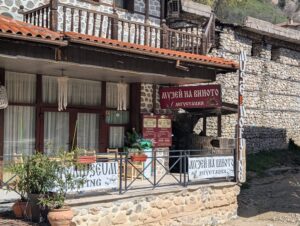
In one of these homes you can find the Wine Museum (Музей на Виното), which gives you the history of the region’s wine-making history stretching from antiquity to the current day. Further along, nestled higher above the town towards the eastern side of the Centre is the Kordopulov House (Кордопулова къща), another museum with rooms restored to represent what the 18th-century merchant house looked like when its original owner, the Greek wine merchant Manolis Kordopulos, lived here. We only had time to pass by quickly, but if you have longer in Melnik, both museums look very interesting.
There are plans to restore other parts of Melnik in the future. In particular, the eastern side has a few things under construction. We don’t doubt that the Centre will become even prettier in the coming years, but now might be the best time to go, before things get too busy.

Hiking St Nicholas’ Plateau: Sand Pyramids and Byzantine Ruins
Duration: 1–2 hours.
Price (per person): Free.
Must-see/Skippable: Must-see.
Location: Start at the archway leading to the Chapel of the Virgin Bogoroditsa Spileotisa. Pass by the ruins of Saint Haralampius Monastery, St Nicholas Church, and the Despot Slavova Fortress (no Google Maps links, but see Komoot route below). Finish back on Melnik’s main street.
By far our favourite part of Melnik was the relatively short and easy hike up St Nicholas’ Plateau, the large hill running along the city’s south. We were led by our Traventuria guide, who gave our group of 8 the chance to visit the Kordopulov House or join him on the hike. Only us and one other guy chose the hike, and we did not see anyone else on the trail, so the walk was incredibly peaceful.
If you don’t have a guide, then don’t worry! There isn’t that much info online about the is route, and Google Maps isn’t of much help navigating the Plateau. However, the route is pretty simple to follow and has occasional signposts. You can also use this Komoot map we created. To save the route, just click on the map’s title.
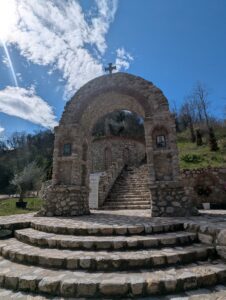
With a moderate level of fitness and decent shoes, in good weather you can do this 2.6KM route in less than an hour, not accounting for any time you spend at the stops. The hardest part is the start, where you ascend several steps to the beginning of the route. While climbing the stairs, look back occasionally to get stunning views of Melnik nestled in the Pirin Mountains.
Once you’ve climbed the stairs, immediately on the left you’ll see the Chapel of the Virgin Bogoroditsa Spileotisa, a small modern church built on the site of a 13th-century monastery. The views from here are also beautiful, as they are pretty much the entire way along this route.
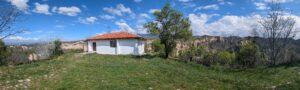
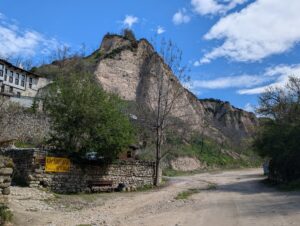
Following the route westwards will take you along some narrow paths, giving great panoramas of Melnik’s Sand Pyramids. These naturally formed, jagged sandstone cliffs are constantly changing, being worn away into new formations. You can see a similar Karst landscape in the Stob Pyramids, closer to Rila, but we enjoyed Melnik’s scenery enough that we didn’t feel a need to visit the other ones.
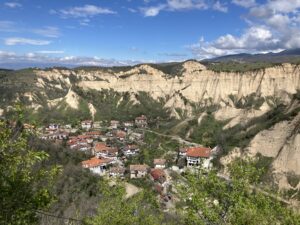
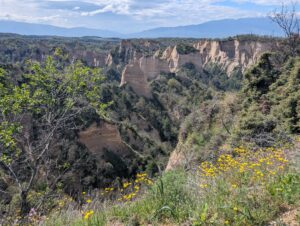
Continuing on, you will come to three 13th-century Byzantine ruins: the Saint Haralampius Monastery, the St Nicholas Church, and the Despot Slavova Fortress. All are quite impressive, but not restored. While the Fortress is pretty small, it’s also notable how defensible the location is, and how thick the walls were. From the ruins, you can pass by many viewpoints which reveal how dramatic and beautiful the landscape is here.
After seeing these ruins, it’s time to make your way back down. You can double-back and go down the stairs next to the Chapel, but equally you can take a slight short-cut, heading closer to Melnik’s main road. Be careful about footing if taking the shorter route, as it gets a little steeper and more precarious here.
Wine Tasting
Duration: 10 mins–1 hour.
Price (per person): Depending on where you go, free (if buying a bottle) to €30.
Must-do/Skippable: Must-do.
Location: Either at the Wine Museum, Kordopulov House, Villa Melnik, or one of the many stores on the main road.
After your hike, we recommend celebrating by indulging in Melnik’s other best thing to do: sampling some of its historic wine. There’s evidence of wine-making in Bulgaria from around 6,000 years ago, with Melnik being especially well-known owing to its temperate climate and good soil. Some stories say that Winston Churchill, probably the UK’s most famous Prime Minister, loved Melnik’s wine so much that he found ways to import barrels of the alcohol to England even during WW2.
Today, you don’t have to be so well-connected to try the wine. You can go to pretty much any restaurant in Melnik. There are many options on the main street, but sadly we did not try any, so we don’t have specific recommendations for wine or food here.
You can also get tasting menus as part of your entry to the Wine Museum and the Kordopulov House. For the most elevated experience, and if you have a bit more time and a car, you can head south of Melnik to the Villa Melnik, a winery that offers tours of its estate and cellars.
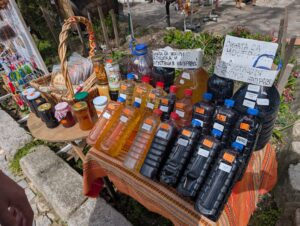
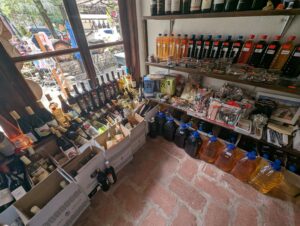
We had limited time and no car so we planned just to grab a bottle from a shop and leave. However, we found that every shop selling wine was keen for us to taste their stuff before we picked what we wanted. You can get red, white, rose, and fruit wines, but the most famous and classic wine is the red Shiroka Melnishka Loza, the Broadleaf Melnik variety. There’s also a few other Melnik-specific varieties you’ll be encouraged to try. We had two reds, two whites, a rose, and a raspberry wine, all served in plastic cups, which was fine for us! All tasted great and were free as we bought a bottle of the Shiroka (€4) and some blueberry wine (€4.25). The shop-keeper was very lovely, and talked us through what we were tasting and with what we could pair each wine.
Unfortunately, most of the shops are not on Google Maps, so we can’t give a specific location. But you cannot miss these shops: they are on the main street, with bottles and bottles (both plastic and glass) stacked outside, waiting to tempt you in. We really enjoyed our quick tasting, and recommend going to a shop, as you will get better value and probably try more that way.
That’s our (very) short route for Melnik! You could easily expand this itinerary by stopping at some of the museums and restaurants in the centre, or travelling to the nearby Villa Melnik, or even walking a bit further to Rozhen Monastery, a small-scale monastery with roots in the Medieval period and more views of the sandstone cliffs. You could also travel further into the Pirin Mountains, or spend some time in Bankso, which is not too far away.
But we really enjoyed our half-day in Melnik, and really recommend a visit, however long you stay. If you do go, let us know in the comments how it went. We heard there’s plans to restore and develop beyond the main street. The next few years look very interesting for Bulgaria’s smallest town, which might become busier in the future. So, now is a very good to go!