

We have to be honest: Bulgarian cuisine is not our favourite. Some dishes we enjoyed and will definitely cook at home. Other things we probably would not order again, even though we were glad to try them. Bulgarian food also tends to be quite heavy, although there are exceptions (we’re looking at you, tarator!).
Even so, the mix of historical influences you can taste and smell in Bulgarian food and drink is really striking: the Thracian and Roman wine-making roots; the medieval Slavs’ bread-making, cheese, and fermented dairy traditions; the Ottoman spices; and the Communist limitation of available ingredients. All left their mark on Bulgaria’s cuisine.
As always, we couldn’t try every traditional dish. We missed out on Snezhanka (a yoghurt-based dip, like a much thicker Tzatziki), Kyopolou (an aubergine, pepper, and garlic spread), and Schkembe chorba (tripe soup). But we still managed to gobble down a diverse range. So, here’s our collection of must-try food and drink Bulgaria.
While you can find these things across Bulgaria, we’ve included Google Maps links for where we tried them in Sofia. Just click on the restaurant names!
Добър апетит! (Dobar apetit: Enjoy your meal!)
1. Mekitsa (Мекица)
Description: Fried dough made with yoghurt and yeast. Similar to but lighter than Lángos. Served with various toppings.
Sweet/Savory: Traditionally sweet, with sugar, jam, fruit, and/or sirene (white brined cheese, like Feta). Savoury toppings are also sometimes used.
When to eat: Traditionally, at breakfast.
Price: €2–4 per piece.
Portion size: Because it can be a bit sweet and/or oily, one is probably enough per person.
Goes well with: A coffee.
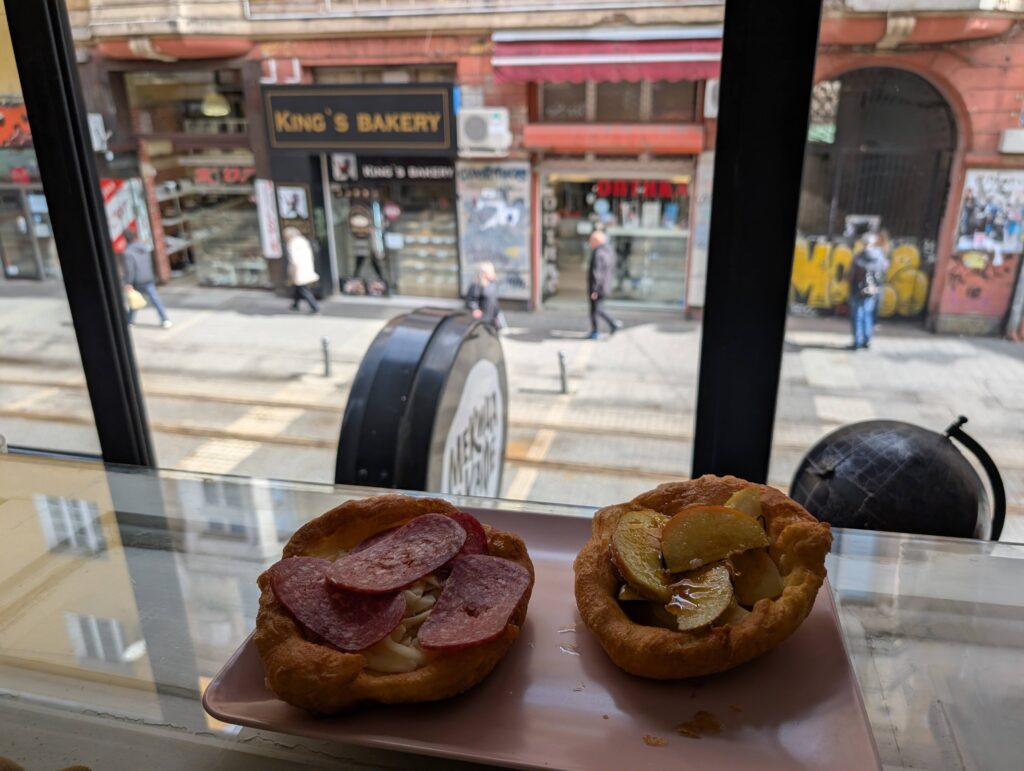
Where to try: The premier place to go is the famous Mekitsa and Coffee (Мекица и Кафе), which serves both sweet and savoury versions alongside hot drinks:. We tried one with caramelised apples and one with kashkaval (yellow cheese) and lukanka (a Bulgarian salami). Both were nice, but we preferred the apple one. We saw simpler, cheaper versions in local bakeries, and also at the Rila Monastery bakery, but did not try them.
2. Banitsa (Баница)
Description: Filo pastry filled with various fillings, most often sirene and/or spinach. Similar to but lighter than the börek common to the Balkans.
Sweet/Savory: Traditionally savory, but sweet fillings are also sometimes used.
When to eat: Traditionally, at breakfast. Also makes for a good snack to pack in your bag.
Price: €1–4 per piece.
Portion size: One is enough for a hungry person. Bigger pastries can be shared or saved for later.
Goes well with: Ayran or boza.
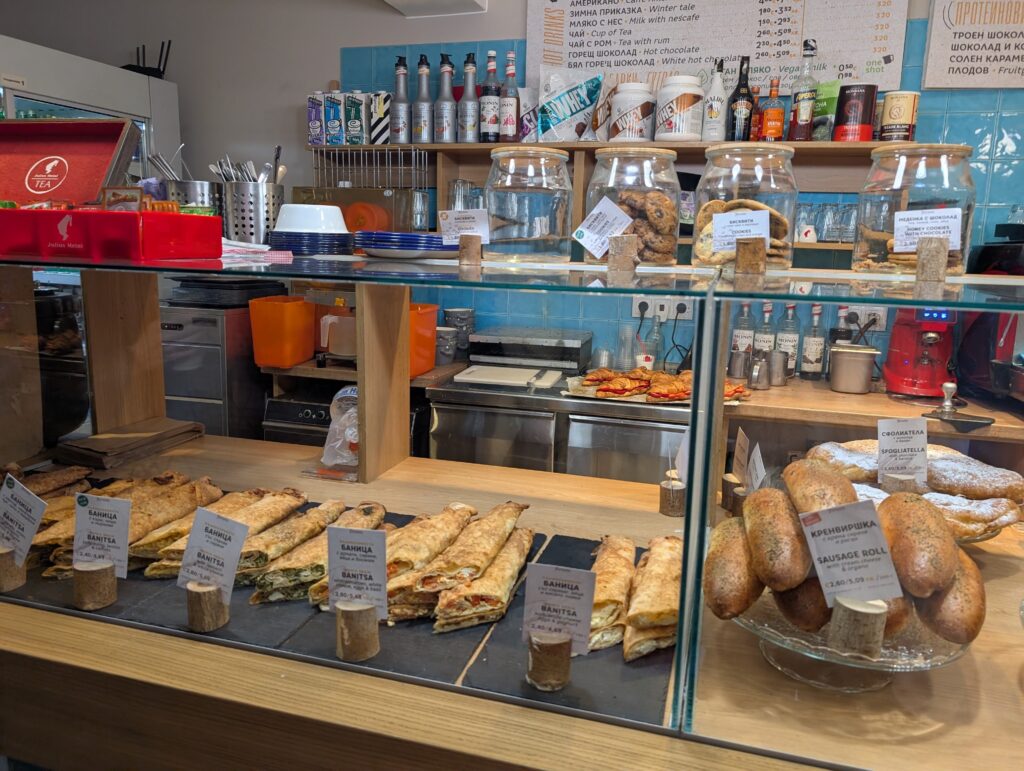
Where to try: Banitsi are common across Sofia and Bulgaria. We had our first one at the well-named Delicious Bakery (Вкусната пекарна) near our accommodation. More elevated examples, with less common fillings such as leek or sweet pumpkin, can be found at Furna. We enjoyed the spinach and the pumpkin banitsi from the Lozenets location, especially as it’s close to a Metro station that takes you to the airport.
3. Shopska Salad (Шопска салата)
Description: A cold salad of diced tomatoes, cucumbers, onion, roasted peppers, and sirene, dressed with salt and oil. Similar to Greek Salad. Very refreshing.
Sweet/Savory: Savory.
When to eat: Any meal.
Price: €3–9.
Portion size: One is enough for one person, but can also work well shared between two people as a side to heavier meat dishes.
Goes well with: Rakia.
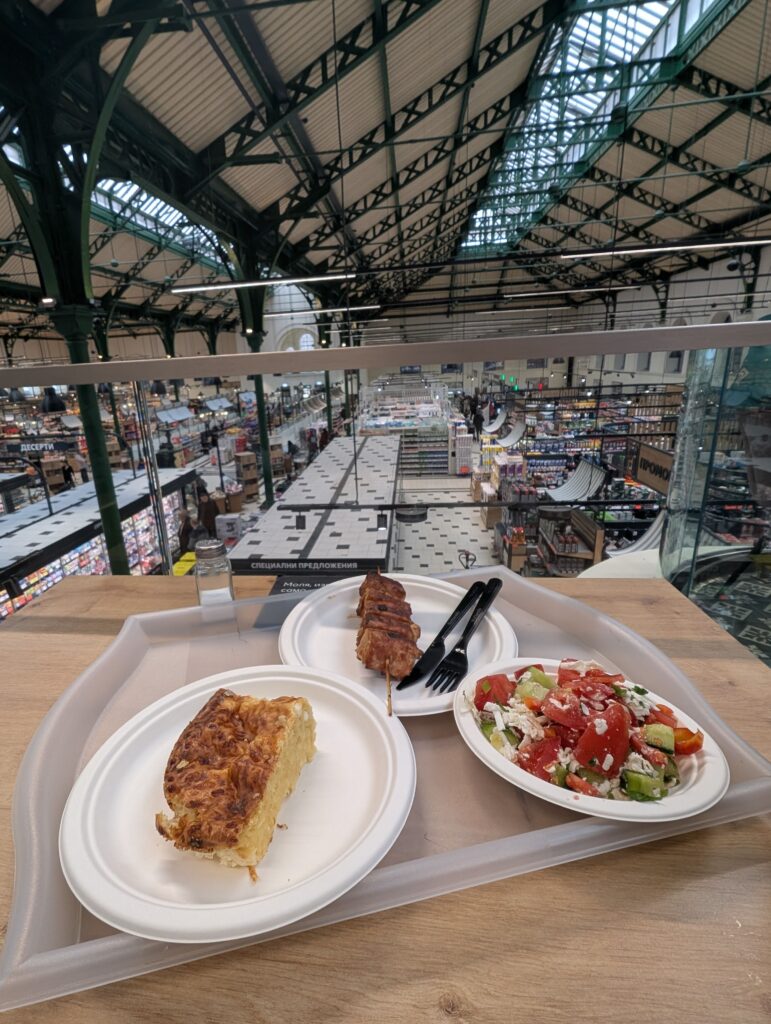
Where to try: This salad, one of Bulgaria’s national dishes invented during the Communist period and matching the colours of the Bulgarian flag, can be found in most Bulgarian restaurants. We tried it at the surprisingly good food court at the Central Market Hall of Sofia, which is now just a large Kaufland. While some people think the salad is too simple, we found it super refreshing after having a lot of meat-heavy dishes. Side note: as you can see in the photo, we had the salad alongside another traditional food, patatnik (пататник), a potato pie from the Rhodope Mountains. It was very hearty and tasty, but not as common in Sofia’s restaurants as it’s typically a homemade dish.
4. Soups: Tarator (Таратор) and Teleshko Vareno (Телешко варено)
Description: Traditional dishes. Tarator is a yoghurt-based soup, made with cucumber, dill, and walnuts, served cold. Teleshko vareno is a slow-cooked beef and vegetable broth, served hot.
Sweet/Savory: Savory.
When to eat: Lunch or dinner.
Price: €2–4 per bowl.
Portion size: One bowl, often served with bread, is enough for one person. If you are hungrier, consider getting a side, or splitting a soup between two people as a side to other dishes.
Goes well with: Bread, sarmi, and any drink. Warm drinks go especially well with tarator, even if it’s not super traditional.
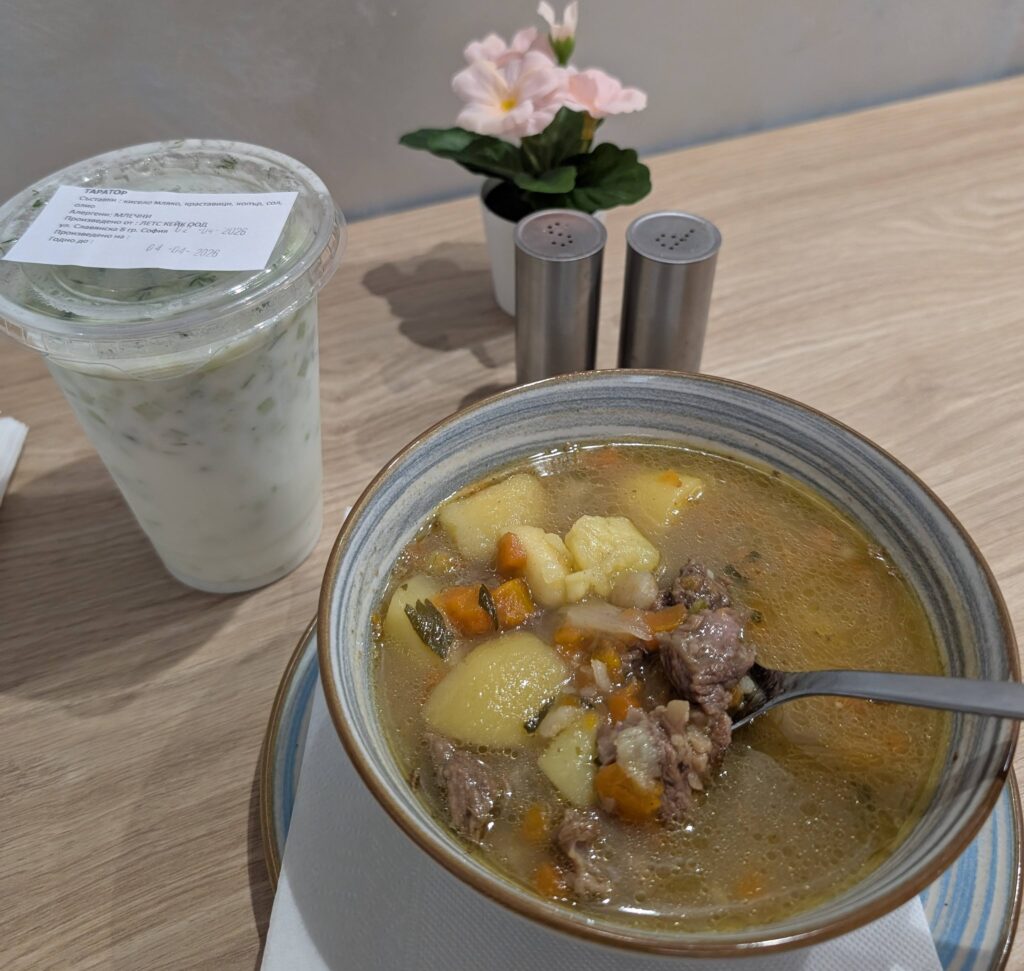
Where to try: Many Bulgarian restaurants will serve tarator, as it’s one of the country’s traditional dishes. Teleshko vareno is a little bit less common, but is still a local comfort food. We tried both at Hungry Station (Гара за Гладни). Don’t be fooled by the Google Maps description: this is not a fast food place, but a local lunch spot, mostly used by nearby office-workers. As a result, dishes come out super quickly and are very affordable. We enjoyed both soups, and would definitely go back! We strongly recommend this place, especially as you’ll probably be the only non-Bulgarians there. However, the menu regularly changes. The Tarator, kept in the fridges at the bottom of the stairs, seems to be a regular thing, but the Teleshko vareno may not be there all the time. If it’s not, you could try one of Sofia’s dedicated soup restaurants, which sadly we didn’t get to try. Supa Star (Супа стар) and Supa Bar (Супа бар) have excellent reviews.
5. Kebapche (Kебапче) and Kyufte (Kюфте)
Description: Classic BBQ meats, with variations common across the Balkans. A kebapche is a rolled minced meat tube, and a kyufte is a meatball. Both are often spiced with cumin.
Sweet/Savory: Savory.
When to eat: Lunch or dinner.
Price: €2–3 per item.
Portion size: Most places serve portions of 2–3 items per person. With sides and sauces, this is normally enough.
Goes well with: A salad, sauces, chips or potatoes, and a cold drink.
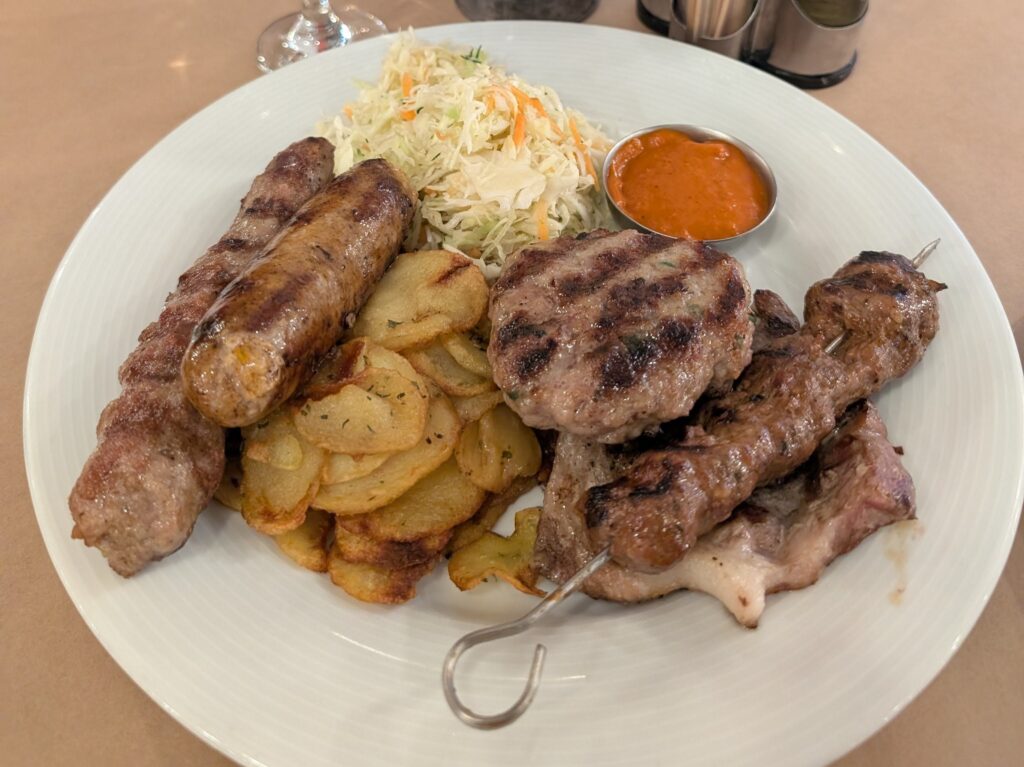
Where to try: You are rarely far from a place that serves kebapcheta and kyufteta in Sofia. We tried both as part of a mixed meat platter at the well-rated SkaraBar (СкараБар). SkaraBar’s meats were well-prepared and balanced with a nice salad and side sauces. That said, we can’t claim to be the biggest fans: for us, the meat is a bit too greasy with too little seasoning. For other, cheaper options, look for signs with cкара (skara, ‘grill’), or go to one of the local BBQ chains, such as Beshamel (Бешамел) or BDS Balkan Grilled Delicacies (БДС Балкански Деликатеси на Скара). You can often also buy hot kebapcheta and kyufteta in bigger supermarkets.
6. Kavarma (Kавърма)
Description: Slow-cooked stew of pork, pepper, and onions, cooked and served in a clay pot. Sometimes served with chicken instead of pork, and optionally with an egg on top.
Sweet/Savory: Savory.
When to eat: Dinner.
Price: €10–20.
Portion size: With some bread or a side, one provides a hearty meal for one person. You could also share it between two people with more sides.
Goes well with: Rice, potatoes, or bread, alongside a salad, red wine, and yoghurt.
Where to try: Another traditional Bulgarian dish, on the heavier side but pretty flavourful. We tried one at the famous Hadjidraganov’s Houses (Хаджидрагановите къщи). While it’s definitely worth going to the Houses to see the interesting preserved exterior and interior (separated into separate buildings from different parts of Bulgaria), we weren’t super impressed with the food. It is a pretty touristy restaurant, so maybe that shouldn’t be too surprising. But you can find kavarma at pretty much every bigger Bulgarian restaurant in Sofia.
7. Sarmi (Сарми)
Description: A mix of minced pork, rice, and herbs, wrapped in cabbage or grape vine leaves. The vine leaf variations are similar to Greek dolmades, and the cabbage ones are like Ukrainian holubtsi, but the Bulgarian versions are slightly less flavourful.
Sweet/Savory: Savory.
When to eat: Lunch or dinner, as a starter or a side.
Price: €4–10.
Portion size: Most places serve three or more sarmi as one portion.
Goes well with: Meats, stews, and soups.
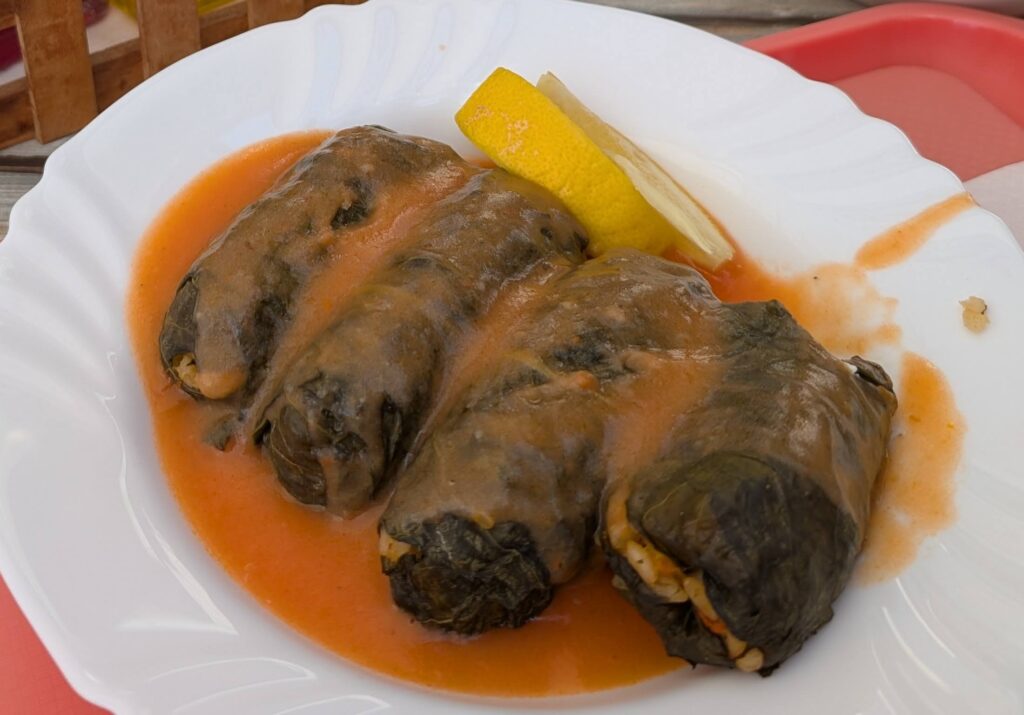
Where to try: As a traditional comfort food, you can find sarmi in many Bulgarian restaurants. We had some really nice ones at Hungry Station (Гара за Гладни), to go with our soup. However, as we noted above, the menu changes quite frequently, so Hungry Station might not do them when you go. If not, your best bet is to try one of the many pubs and restaurants that focus on Bulgarian home-cooking.
8. Princesa (Принцеса)
Description: Bulgarian cheese-on-toast/grilled cheese/open-faced baked sandwich. A long slice of bread with melted cheese and various meat toppings, often with a sprinkle of sharena sol (шарена сол, colourful salt) a spice mix of savory, paprika, fenugreek, salt, and (sometimes) thyme. Also often topped with a drizzle of mayonnaise, ketchup, and/or chilli sauce.
Sweet/Savory: Savory.
When to eat: When you want a quick bite on the move.
Price: €2–3.
Portion size: One is good for a big snack. Two would come closer to a meal.
Goes well with: A cold beer or soft drink.

Where to try: While open-faced sandwiches are made in quite a few Balkans and Eastern European countries, Princesi are a very Bulgarian thing. They’re pretty simple and don’t change too much between different sellers, but they really do hit the spot. The best ones we tried were at Sandvichite (Сандвичите), which also offers a range of sandwiches and hot dogs. Even better, the place is open 24/7, so this is the place to go for a late-night snack.
9. Street Pizza
Description: It’s pizza… from the street! Served on many corners of Sofia and other cities by uncles a slice at a time, topped with varying combinations of pepperoni, ham and mushroom, corn, sausage, and (sometimes) pickles and chicken. Can be square or triangular slices, with the base on the thicker, breadier side.
Sweet/Savory: Savory.
When to eat: When you want a quick bite on the move.
Price: €1.50–3.
Portion size: As slices are pretty big, one is perfect as a big snack, especially if you’re hungry.
Goes well with: A cold beer or soft drink.
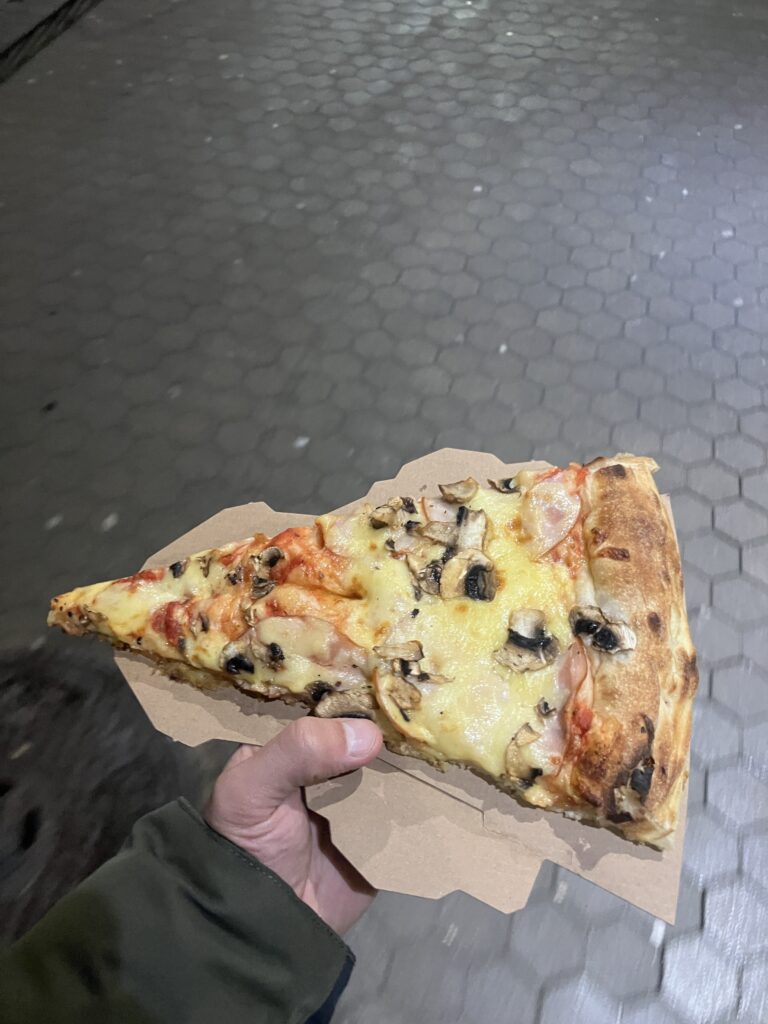
Where to try: There is pizza everywhere in Sofia. We were super surprised how frequently we saw little stalls selling slices, and how popular they were, especially with younger Bulgarians. As with many western fast foods like McDonalds, pizza became popular in the post-Communist period, with people flocking to what were seen as ‘Capitalist freedom’ foods. Scone’s family told him that this was the case in Ukraine after the country gained independence, so it’s not too surprising to find the same in Bulgaria. The first slice we tried was a sausage and mushroom one near our apartment, at Bad Habits, and it was delicious. As a bonus, we tried some Carrot cake (Морковена торта), which was way more flavourful than other Carrot cakes we’ve tried. So, we recommend trying both out, if you have space in your stomach! For thinner New York-style slices, try out Slice Pizza, which is a bit more expensive but also very tasty.
10. Lyutenitsa (Лютеница)
Description: A vegetable chutney, made from peppers, aubergines, carrots, garlic, oil, sugar, salt, tomatoes, and walnuts.
Sweet/Savory: Savory.
When to eat: Alongside other meals, as a side.
Price: €1.50–4.
Portion size: You can eat a surprising amount of lyutenitsa in one go. Restaurants often serve a small bowl alongside your other food, but sometimes also offer it in a larger sharing portion.
Goes well with: Bread and grilled meats.
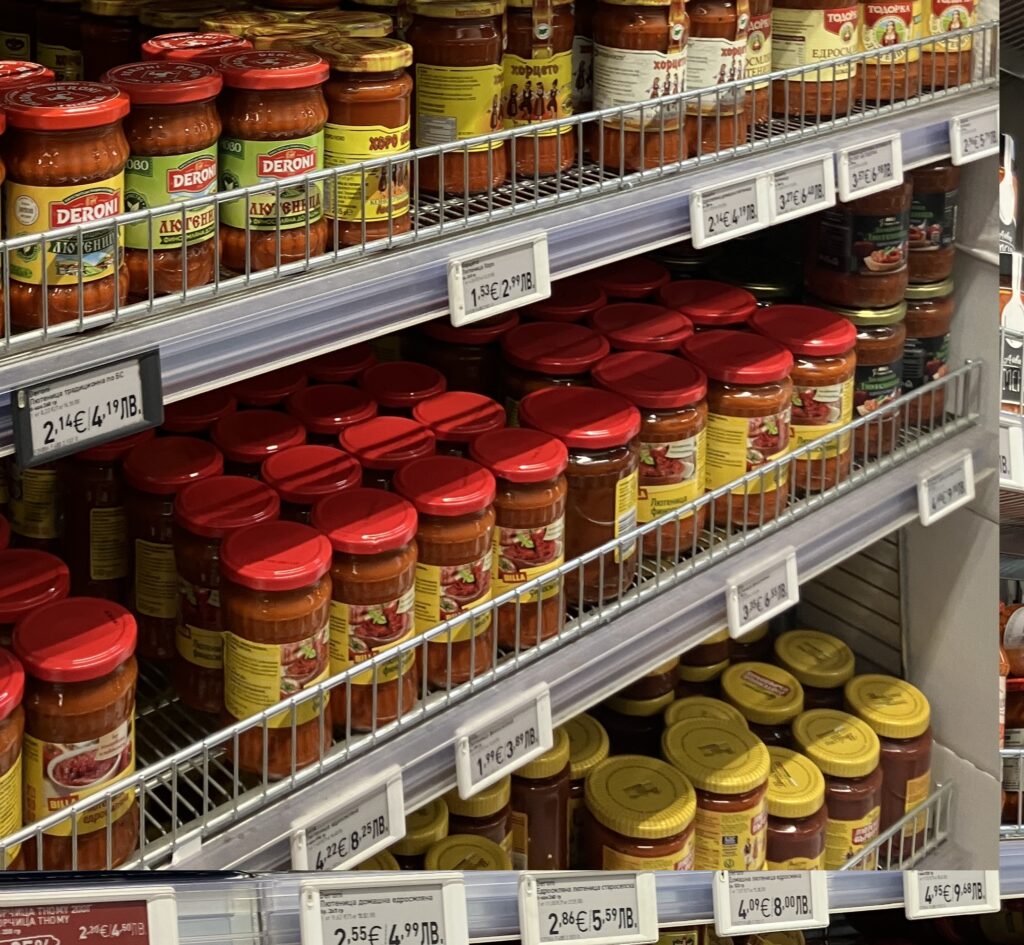
Where to try: Lyutenitsa is another common staple of Bulgarian food. We tried it in Hadjidraganov’s Houses (Хаджидрагановите къщи) and SkaraBar (СкараБар) alongside other things, and it was great both times. We saw it on the menus of most Bulgarian food places we visited, so there’s no need to hunt it out separately. That said, most Bulgarians often have it at home, whether homemade or bought from a store, and we saw loads of different types in supermarkets. A more local experience would be to buy a jar from a supermarket alongside some bread, then have a picnic somewhere.
11. Parlenka (Пърленка)
Description: A light and airy flatbread, often brushed with butter, herbs, and garlic.
Sweet/Savory: Savory.
When to eat: Alongside other meals, as a side.
Price: €2–5.
Portion size: As a side, one can be shared between two people.
Goes well with: Meats, stews, soups, and lyutenitsa.
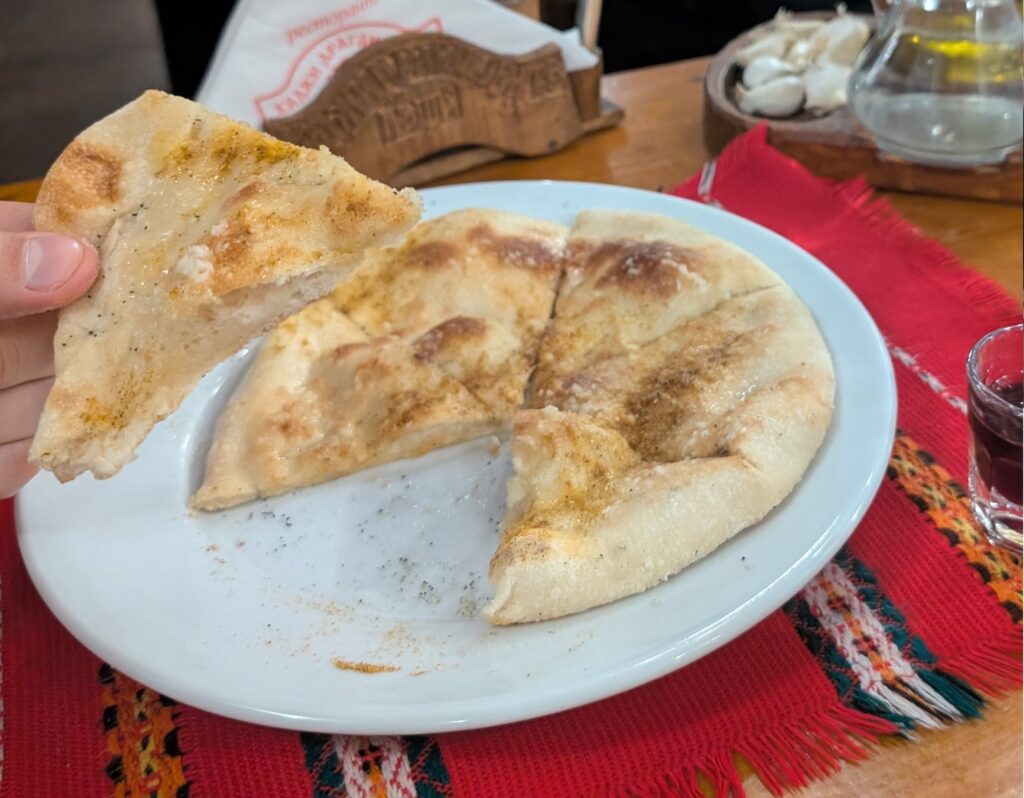
Where to try: Yet another traditional food, offered in pretty much every Bulgarian food place. We had a great one in Hadjidraganov’s Houses (Хаджидрагановите къщи). As with lyutenitsa, you shouldn’t have to look too far to find it.
12. Buffalo Yoghurt (Биволско кисело мляко)
Description: A thick, slightly savoury, and unflavoured yoghurt traditionally made from buffalo milk, although now often mixed with cow milk. Similar to Greek yoghurt but much thicker and silkier.
Sweet/Savory: Savory.
When to eat: Alone as a snack, as a topping/accompaniment for lunch or dinner, or with breakfast cereal and fruit.
Price: €3–6.
Portion size: As a snack, one pot is enough for two people in one sitting. As a topping, a few spoons is great.
Goes well with: Most savoury foods, cereals, and fruits.
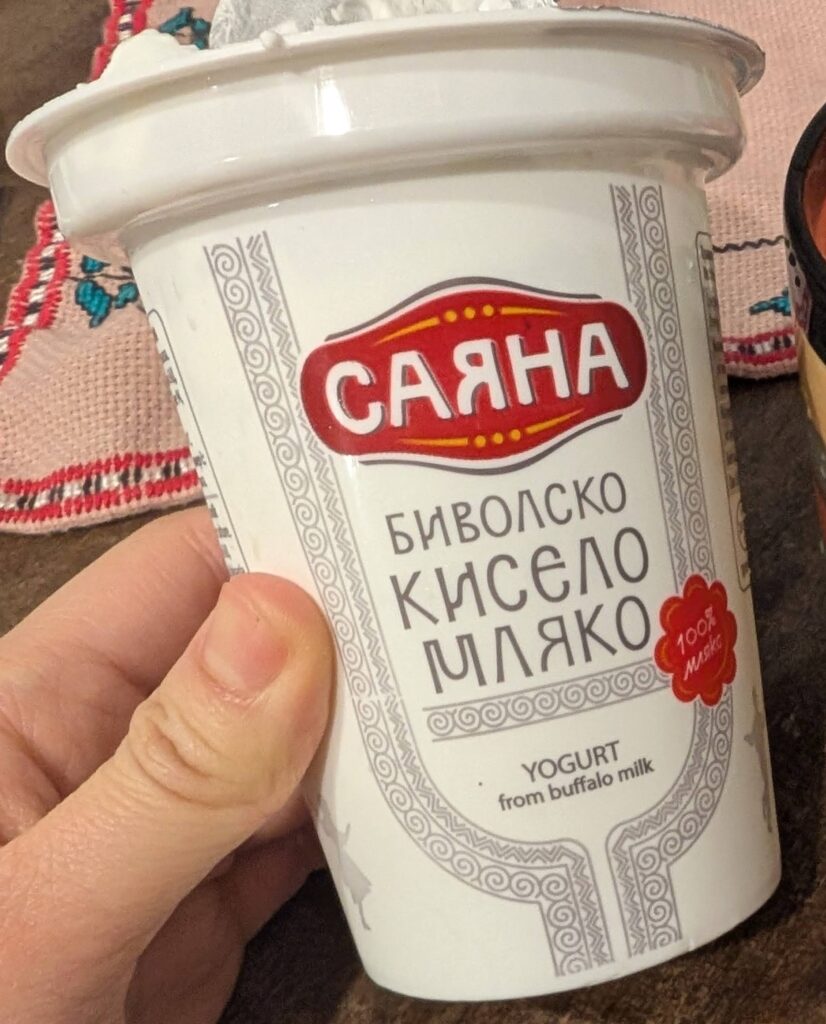
Where to try: Some Bulgarians claim that yoghurt was originally discovered by Bulgaria’s ancient nomads. Whether this is true or not, yoghurt is pretty common here, with buffalo yoghurt being especially well-known for its tastiness, creaminess, and health benefits. We didn’t see it on any restaurant menus, but it’s a core ingredient in many recipes. A few bakeries offer it as a snack, including the bakery at Rila Monastery, which is particularly famous for its yoghurt. However, we recommend just getting some from a supermarket. We got a 450g pot from the Central Market Hall of Sofia for €3.50, and it was delicious.
13. Boza (Боза)
Description: A fermented cereal malt drink. As it is thick and has a tangy, semi-sweet flavour, people tend either to love it or hate it.
Sweet/Savory: Sweet.
When to drink: Breakfast
Price: Around €1–2.
Portion size: A small, 330ml bottle is more than enough for one person. You can also buy it in larger quantities.
Goes well with: Pastries, especially banitsi.
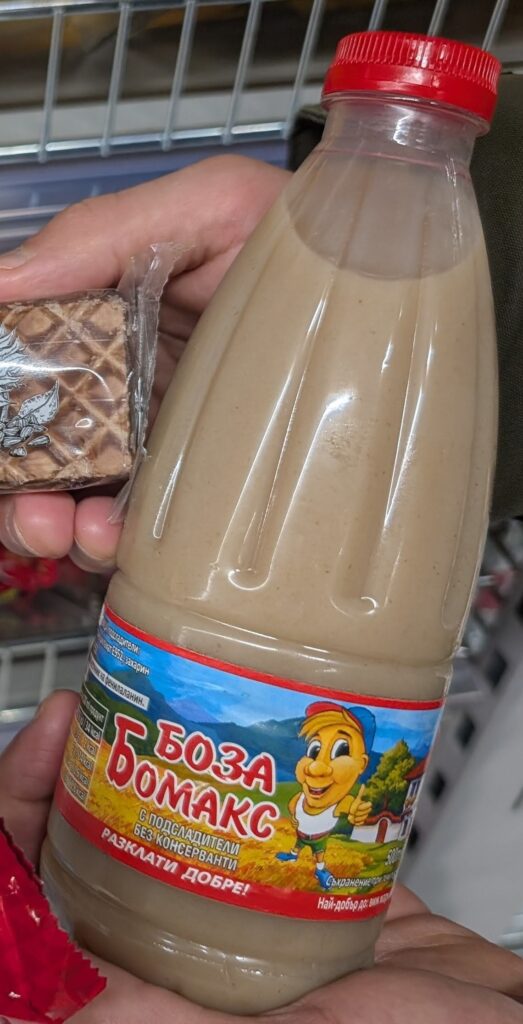
Where to try: This pretty unique malt drink is definitely worth trying, so long as you go in with an open mind. We thought it tasted much better than expected, but your experience may differ! It’s mostly mass produced now, so it doesn’t matter where you get it. We had a bottle from Delicious Bakery (Вкусната пекарна) near our accommodation, but the same bottles are sold in all supermarkets and most bakeries.
15. Rakia (Pакия)
Description: A strong (40–60% ABV) fruit brandy.
Sweet/Savory: Savory, with a hint of sweet.
When to drink: As an aperitif or digestif.
Price: In a bar, €3–6 per glass. In a supermarket, €10–20 per bottle.
Portion size: With food, one 50ml glass is probably enough per person, but we’ll leave that judgement up to you…
Goes well with: Meats and salads.
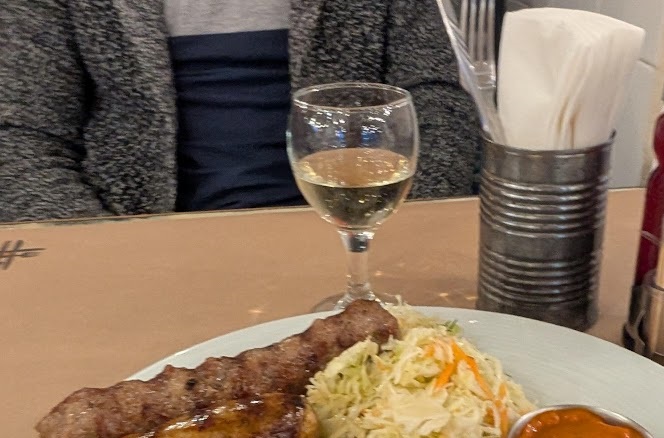
Where to try: Versions of rakia are common across the Balkans. The Bulgarian rakia is a little sweeter than others, but be warned: it’s still very strong. We weren’t the biggest fans, even though we got a nice one at SkaraBar (СкараБар). Rakia is another thing for which you don’t need to hunt. You can find it at most bars and Bulgarian restaurants.
16. Red wine (Червено вино)
Description: No surprises here: it’s red wine! Bulgarian red runs on the fruitier side. Particularly notable is Shiroka Melnishka (Широка мелнишка лоза), produced in Melnik but often available across western Bulgaria.
Sweet/Savory: Sweet.
When to drink: With lunch or dinner.
Price: In a bar, €3–6 per glass. In a supermarket, €7–20 per bottle.
Portion size: With food, one 125ml glass is probably enough. But as with Rakia, you may want more.
Goes well with: Stews, meats, and cheese.
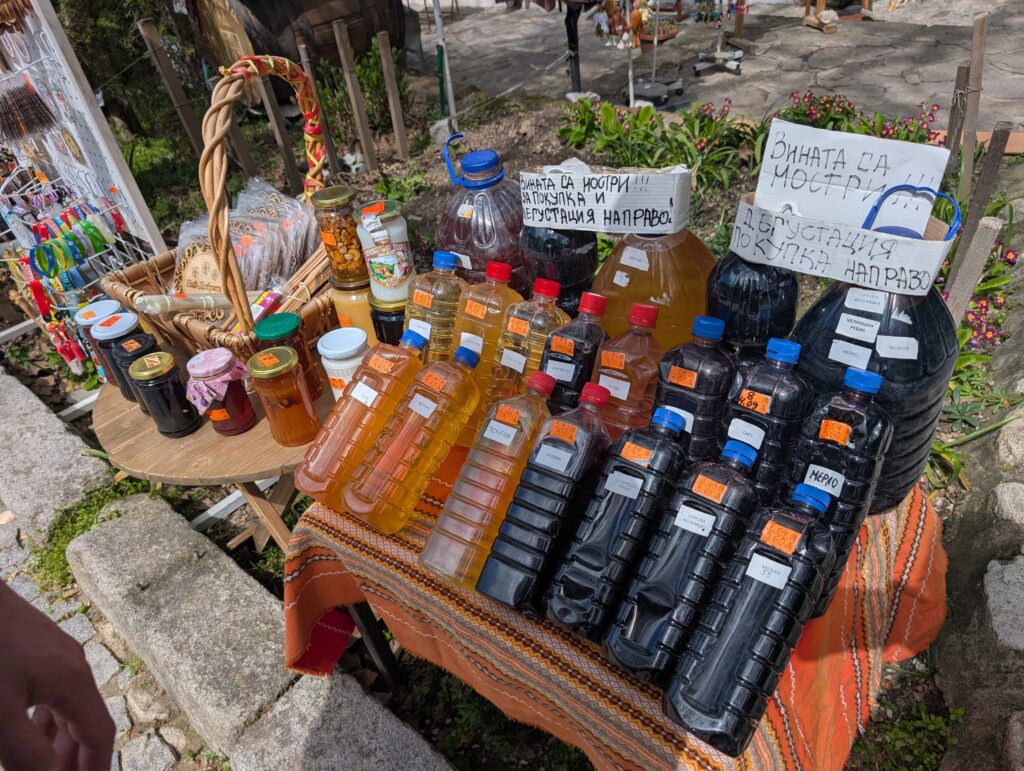
Where to try: Full disclosure: we first tried the Melnik wine in Melnik, as part of a wine tasting. If you can do the same , you’ll have a great time. However, don’t expect the same quality as you’d get in France, South Africa, or Chile. We saw various red wines, including the Shiroka Melnishka, at numerous bars, including SkaraBar (СкараБар) and Hadjidraganov’s Houses (Хаджидрагановите къщи). So, as with essentially all the recommended drinks, you probably won’t need to go to one specific location to try it.
17. Coffee Machines
Description: Well, it’s coffee from a vending machine! Often a small cup (at most, 200ml), with varied ranges of black and white coffee. Decaffeinated options and the ability to increase or reduce the sugar level are sometimes offered.
Sweet/Savory: Either sweet or savory, depending on coffee type.
When to drink: Any time you see one.
Price: At most, €1 per cup. Most machines only accept coins.
Portion size: Between 30ml and 200ml.
Goes well with: Snacks and cakes.
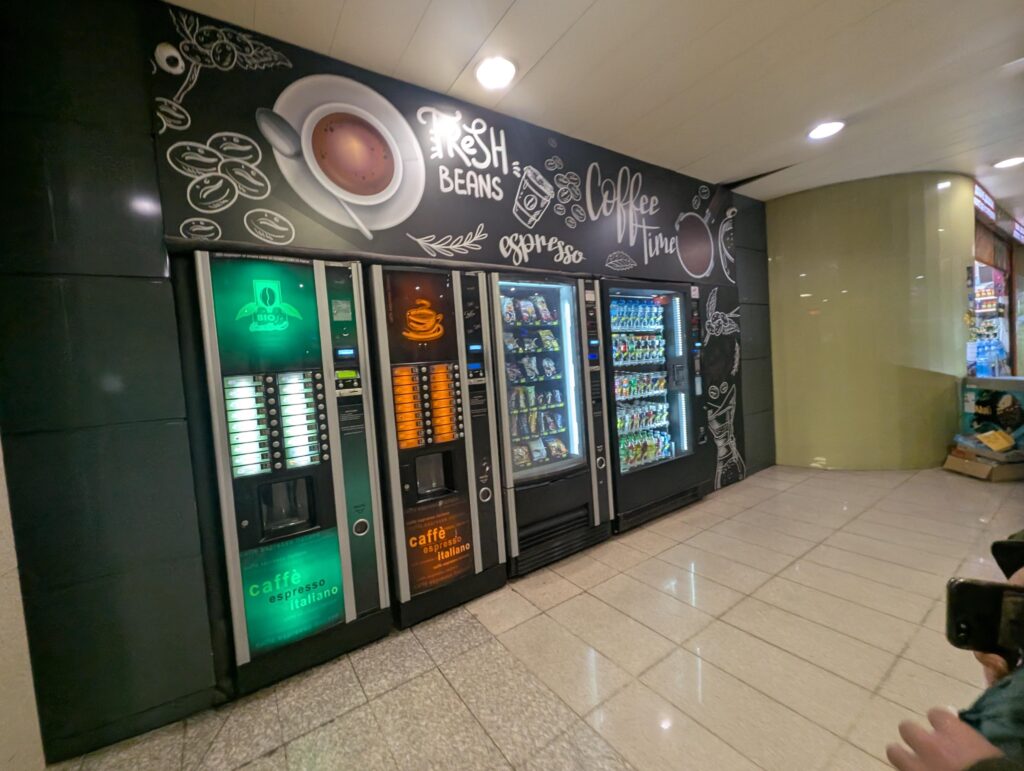
Where to try: This may seem a weird entry, but we were very surprised at how many coffee machines we saw across Bulgaria. Sure, lots of places have vending machines, especially for hot drinks, at places like bus stations or office buildings. But we lost track of how many we saw in our first day in Sofia alone. We aren’t the first people to notice how frequently you come across coffee machines. There’s even an Instagram account dedicated to documenting them. After maybe the tenth sighting, we decided to try one and let us tell you: it tasted surprisingly good! You can get coffee at most local stores, but the quality of the coffee used and the taste of the sugar, which you can sometimes control before ordering, were better than the coffee we tried in cafes. We also saw a lot of people using the machines, which are generally well-kept and clean. Definitely consider trying one out when you (inevitably) see one in Sofia.