

Pretty much everyone’s second Bulgarian city after Sofia is Plovdiv, and for good reason. It’s only a few hours away from Sofia and, as it’s in a different climate zone, is often much warmer than the capital. Even better, in antiquity, Plovdiv (Philippopolis as it was known under the Romans) was the capital of the province of Thrace. So, expect to see some seriously amazing yet still not widely visited Roman sites.
You could definitely spend a few days in Plovdiv, but in case you don’t have the time to spare, here’s our packed one-day itinerary, which takes in the major sights and goes to some lesser visited restaurants.
Want to spend longer in Plovdiv, or see where else to go in Bulgaria? See our 4-day Bulgaria Itinerary and suggestions for expansion
Itinerary
Travel from Sofia
Duration: 2–4 hours.
Price (per person): €6–10.
Must-do/Skippable: Well, it’s skippable if you’re already in Plovdiv!
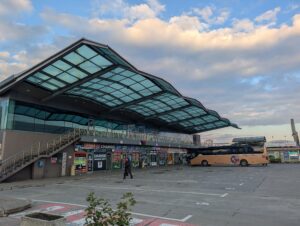
Location: Leave from Sofia Central Bus Station. Arrive at Plovdiv International Bus Station.
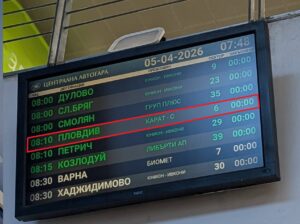
We recommend getting the earliest transport possible. For us, that was the 08:00 bus. Most buses will leave from the Sofia Central Bus Station (Централна автогара на София), which is well-connected by Metro and, probably obviously, bus. The Plovdiv bus leaves from the right side of the Station.
Check inside on the info screens for the bay from which to catch the bus. If you’re unsure, the bus should also have the destination and major stops written on a piece of paper in the windscreen. The names will probably be in Cyrillic. For Plovdiv, you want Пловдив.
Our buses there and back were comfortable, but don’t expect luxury: we didn’t have air conditioning and while there’s clearly been some work done on the E80, the main road between Sofia and Plovdiv, there’s still a few bumpy sections on the way. At the same time, this was a relatively cheap and convenient way to travel between the cities, so we still think it’s the best option.
The bus normally stops at Plovdiv’s International Bus Station (Международна автогара), right in front of the railway station, or a bit further down the road at the Yug Station (Автогара „Юг“).
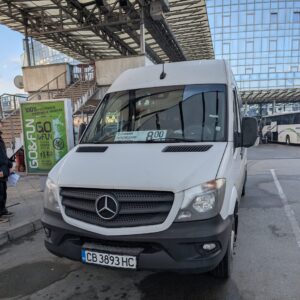
sign in the window before boarding!
Tsar Simeon Garden
Duration: 20–30 mins.
Price (per person): Free.
Must-see/Skippable: Skippable, but on the way to the next few stops.
Location: Here.
A 10-minute walk north takes you to the edge of the Tsar Simeon Garden (Цар Симеонова градина), a nice park with a playground, some sculptures and monuments, lots of trees, and (on summer nights) a light-up fountain display. There’s also public toilets on the south side and an open square towards the north.
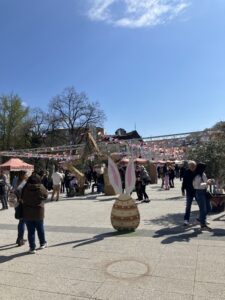
As we visited the Sunday before Easter, there was a food market in the square for Tsvetnitsa (Цветница), ‘Flower Day’, which is similar to Palm Sunday in other Christian traditions but more broadly a celebration for people with flower-/tree-related names. On this day, women in Bulgaria are gifted flowers and are often seen wearing crowns of willow branches which have been blessed in churches. If you can come around this time, it definitely adds to the experience!
Brunch: Torti Chochko
Duration: 30 mins–1 hour.
Price (per person): €3–10.
Must-try/Skippable: Must-try.
Location: Here.
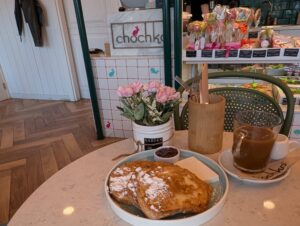
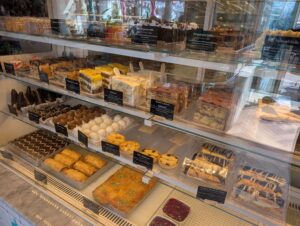
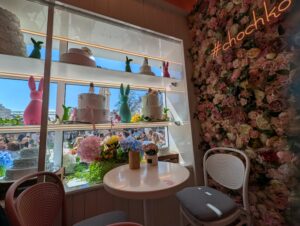
Just north of the Tsar Simeon Garden is Torti Chochko (Торти Чочко), a cute and popular cafe with a big outdoor area and the best cakes we tried in Bulgaria. We strongly recommend coming here for a late breakfast, as the food comes in big portions and is very tasty. The coffee is also pretty good and the staff are lovely. We had the Bulgarian version of French Toast, called Parjeni filiiki (Пържени филийки), served with sirene cheese, jam, and sugar. The food comes out pretty quick, but it’s easy to spend at least an hour here, especially if you can sit outside to enjoy the atmosphere and the view of the park.
Want to know other things to eat and drink in Bulgaria? See our Sofia food guide!
Roman Forum and Odeon
Duration: 30–45 mins.
Price (per person): Free, unless paying to enter the Odeon’s tunnels (€3.58).
Must-see/Skippable: Must-see.
Location: Forum. Odeon.
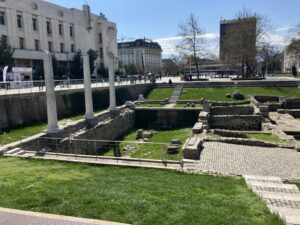
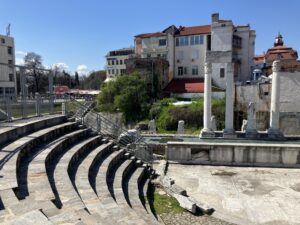
Just south of Torti Chochko and in the Tsar Simeon Garden is the first of Plovdiv’s many Roman sites. Here, you have parts of the Forum, the administrative and economic centre of the Roman city of Philippopolis. Inside the Garden is a small section, with one street, several buildings, and a restored part of the propylaea, the colonnade that runs around the Forum. You don’t need to spend more than 10 minutes in this section.
A 5-minute walk west takes you to the Odeon, where you have other parts of the Forum alongside the Odeon itself, originally a bouleuterion (the building where local elites gathered as the city’s council) before being turned into a theatre. You can climb to the top of the Odeon’s stairs to get a view over the Forum, and if you want, you can pay to go underneath in the tunnels.
If you plan to go to a lot of the Old Town sites, it might be worth buying a combined ticket, which gives you entry into up to 5 sites for €11. As the eligible sites are all around €4 to enter, it’s worth it if you go to at least 3, but note that on this itinerary, only the Ancient Theatre and the Odeon’s tunnels are included. We opted not to get the combined ticket and stuck with the Odeon’s above-ground parts, which gave us a good introduction to Plovdiv’s Roman past.
Episcopal Basilica
Duration: 1–2 hours.
Price (per person): €7.67.
Must-see/Skippable: Must-see.
Location: Here.
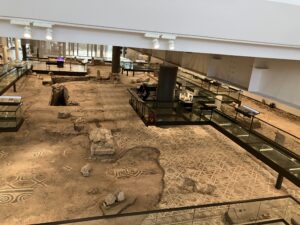
A further 5 minutes of walking west takes you to the excellent Episcopal Basilica, one of the best things to see in Plovdiv. This museum preserves the remains of a large early 4th-century church which was decorated with some incredible floor mosaics and was built over a demolished 1st-century non-Christian temple to the imperial cult. The museum is very well-designed, with lots of information guiding you through the extensive mosaics and the history of the building remains. There’s some children’s displays upstairs to keep kids occupied, large lockers for your things, and shoe covers to prevent you bringing in debris that could damage the mosaics.
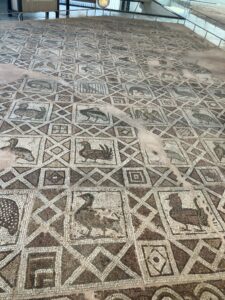
But really, you’re here for the mosaics, which stretch across most of the museum. In person, the opus tessellatum (small coloured cubes set in mortar) is breathtaking. During Late Antiquity (late 3rd to early 7th centuries CE), this part of the Balkans was renowned for its mosaic art, as is reflected by the limited attestation of one Ancient Greek word for the act of making mosaics just to Plovdiv. In addition to many geometric patterns, pay attention to the wide range of birds depicted, meant to represent the diversity of Chistian souls. Other images of note are the many flora, one of which is not any known surviving plant, as well as the donation inscription indicating that this building was a bishop’s seat.
If you have time, you might want to check out some of Plovdiv’s other comparable, but smaller, mosaic museums. In particular, the Small Basilica, a 5th-century CE church paid for by Philippopolis’ citizens to thank Basiliscus, a military commander who defended the city from a Gothic attack. However, as he usurped power from the emperor Zeno in 475 then was himself deposed by Zeno in 476, Basiliscus’ name was removed from the Basilica’s donation inscription. In addition to this inscription, you can also see a remarkable stag mosaic here. The other main option is the Eirene Building, a 3rd-century CE residential building whose wealthy 4th-/5th-century owner paid for a large mosaic depicting Eirene, the personification of Peace.
Ancient Stadium
Duration: 10–15 mins.
Price (per person): Free, unless paying for the 3D demonstration (€3.68).
Must-see/Skippable: Must-see.
Location: Here.
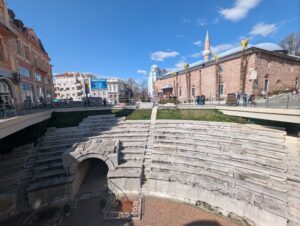
Walking 10 minutes north of the Episcopal Basilica takes you into the bustling heart of Plovdiv, where you can see the Ancient Stadium, a 2nd-century CE hippodrome where horse and chariot races took place. What’s really amazing about the Stadium is that it’s in situ, with the modern street built above it and shops all around it. While most of the track and seating hasn’t been fully excavated, you can see a seating section from the street.
You also get closer and see a reconstruction of the Stadium by getting tickets to the Stadium’s 3D movie demonstration associated. We heard that the demonstration is outdated and not worth the time or money, but if you have some extra time, it might be worth considering taking a closer look. We think it’s more than enough to see the Stadium from above.
Walk through Kapana and grab lunch
Duration: 30 mins–1 hour.
Price (per person): €2–15
Must-see/Skippable: Must-see and, in the case of the food, must-try!
Location: Yogi Foods Pizzeria Halite. Pirozkhi. Festival.
Having walked to the Stadium, you are already in Kapana, Plovdiv’s lively and mostly pedestrianised centre. Here, you’ll find a lot of shops, cafes, restaurants, and bars, so it’s another great place to people-watch and catch some rest.
For us, Kapana was also the perfect place to get some food. We thought about stopping by the local branch of Happy, a Bulgarian chain restaurant which serves a very broad variety of food and is surprisingly well-rated amongst locals, but the queue was too long and we wanted a lighter snack.
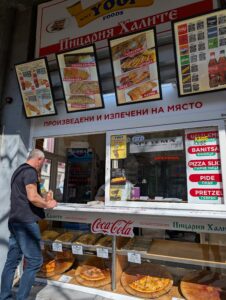
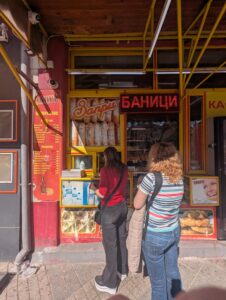
Instead, we went for a combination of street food. The first was Yogi Foods. There’s two locations in Kapana, essentially side-by-side. The one on the right does the usual kebabs and burgers you can find anywhere in Bulgaria. The one on the left, also named Pizzeria Halite, does lighter options, including the usual pizza, which is always great, but also gözleme, a thin, pancakey flatbread, folded and filled with spinach, cheese, or minced meat. You can find gözlemeler across the Balkans, but it’s traditionally Turkish. We had a ham and mushroom pizza slice (€2.50) with a minced meat gözleme (€3.50), and both were delicious.
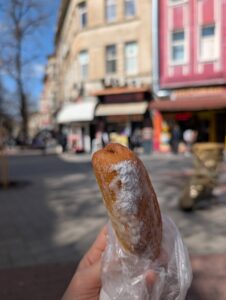
We finished things off with Pirozkhi (Пирожки), an old-style stall selling pastries, including its namesake, the pirozkha, a marmalade-filled yeast bread roll. Variations of pirozkhi are common across the Balkans and Eastern Europe. They’re sweet, tasty, and cheap (€0.72). One is probably enough for one person. We recommend eating them as fresh as possible, as they’re so nice when warm. However, when warm, the marmalade will burn your tongue, so be careful! Right next to Pirozkhi is one of the ubiquitous coffee machines, if you want a hot drink with your pirozkha.
We sat down with our food outside on a bench in the sun. But if you want a restaurant in which to sit down, we also heard good things about Restaurant Festival (Ресторант “Фестивал”), which serves a mix of modern European and traditional Bulgarian grill items.
Ancient Theatre
Duration: 30 mins–1 hour.
Price (per person): €4.
Must-see/Skippable: Must-see.
Location: Here.
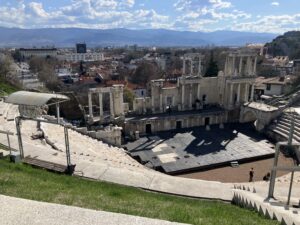
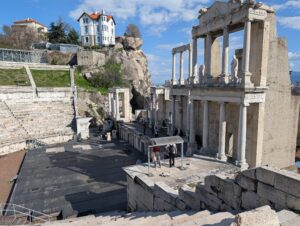
A 10-minute walk from Kapana takes you to one of Plovdiv’s best ancient sites, the Ancient Theatre. Built in the early 2nd century CE, the Theatre gives you commanding views over part of the city and the surrounding valley. While you can technically see a good part of the Theatre without paying by standing next to the ticket stall, it’s very much worth paying for a ticket.
You can climb down the steps and hillside seating (theatron, where we get the word ‘theatre’), go through the orchestra (the circular area in front of the stage, where the chorus sang and danced), and then climb onto the proskenion (the stage) and take a close look at the skene (the backdrop). There are not too many Roman theatres which have been preserved or restored to the same extent as this one.
By design, Ancient Greek and Roman theatres gave panoramic views behind the stage, originally as dramatic performances were part of religious festivals with the gods taking an interest in plays (note also the deus ex machina, where representations of gods were lowered into the theatre to take an active part in the play). For this reason, it’s possible to get some great photos here. When we went, several models were doing a photo shoot on the proskenion, although we have no idea if they had to get permission. In any case, definitely make the Theatre a stop on your route!
Wander the ancient streets
Duration: 30 mins–1 hour.
Price (per person): Free, unless you divert to one of the old town houses or the Regional Ethnographic Museum (€4 each).
Must-see/Skippable: Must-see.
Location: Hindliyan’s House. House-Museum Klianti. Church of Sts Constantine and Helena. Regional Ethnographic Museum.
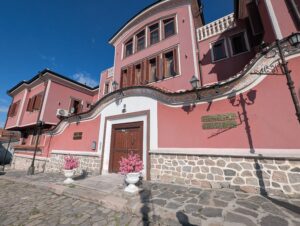
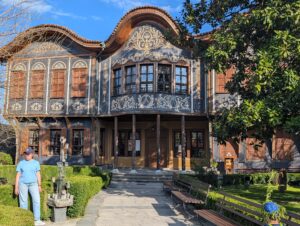
If you leave eastwards from the Theatre then walk north, you are in the historic heart of Philippopolis. Wandering along the cobbles, you can stop to admire many of the Old Town Houses, formerly the homes of wealthy locals. Following several hundred years of Ottoman rule, Bulgaria underwent a Renaissance period in the 18th and 19th centuries, where greater autonomy meant freedom to make whatever architectural decisions Bulgarian elites wanted. This period of National Revival Architecture is reflected in the colourful and intricate decorated Town Houses of Plovdiv. We decided not to go inside any as we were a bit short on time and the weather was fantastic, but we heard that the Hindliyan (light blue) and Klianti (red) Houses were especially pretty.
Further along, you’ll come to the Church of Sts Constantine and Helena (free to enter), dedicated to the Roman Empire’s first Christian emperor and his mother, who in Christian tradition found the True Cross on which Jesus was crucified. Originally built over the foundations of a non-Christian temple in 337, the year that the emperor Constantine died, the Church has been rebuilt and redecorated many times. While very nice, the interior is not too different to other Orthodox churches.
Nearly next to the Church is the Regional Ethnographic Museum, a collection of Bulgarian cultural items. The Museum is very pretty from the outside, as it’s housed in another of the National Revival Old Town Houses. Again, we didn’t have time to go in, but we heard good things about this museum.
Nebet Tepe
Duration: 30 mins–1 hour.
Price (per person): Free.
Must-see/Skippable: Must-see.
Location: Here.
Continue on to the end of the Old Town by climbing one of Plovdiv’s seven hills. As a side-note, many Roman cities were founded, or claimed to be founded, on seven hills, to emulate Rome and its location across seven hills.
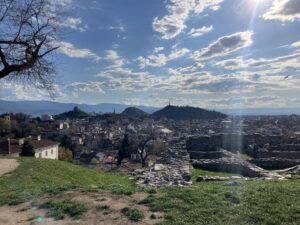
The closest and easiest to climb hill is Nebet Tepe, which functions as an open archaeological park. Here, you have a mix of Thracian (pre-Roman), Roman, and medieval architectural remains, and some really fantastic views over the city. When we went, Nebet Tepe was bustling, with many tourists and locals gathered here for the sunset with a few drinks and snacks. There’s nothing to buy up here, so make sure to take something with you if you want a picnic. Sadly, we didn’t have time to stick around for the sunset, as we had to go back for our bus. But if you can swing by when the sun goes down, the view is meant to be incredible.
Local Dinner
Duration: 30 mins–2 hours.
Price (per person): €5–20.
Must-try/Skippable: Must-try.
Location: Soup Bar. Rahat Tepe.
Finish your day with some local food. If you are heading back to Sofia by bus or train, you have a pretty long walk, at just under 40 minutes, a 10-minute bus journey followed by a 10-minute walk, or a 10-minute taxi. As we decided to walk, we wanted to break up the way back by stopping at a restaurant along the route.
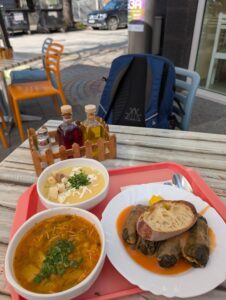
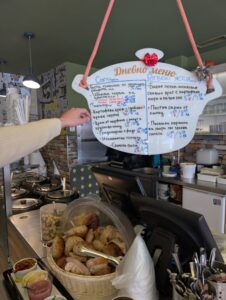
We chose Soup Bar (Супа бар), which, as the name suggests, specialises in Bulgarian soups. For €10.60, we got a potato cream soup, teleshko vareno (телешко варено, a beef and vegetable slow-cooked broth), bread, and sarmi (cарми, vine leaves stuffed with rice, herbs, and minced meat). The food was very delicious and filling, the restaurant was full of locals, and the service was super quick. We would go back for sure!
If you prefer not to wait so long for food, we heard very good things about Rahat Tepe (Рахат тепе), which is right at the entrance to Nebet Tepe. We didn’t try it ourselves, but it was busy both times we walked past and smelled very good. You can then get a bus closer to the station when you’re done.
We loved our time in Plovdiv, and were sad we only had a day there. We’d love to hear how you found the city and our route. What was your favourite part of Plovdiv? Is there anything you’d skip or do again? Let us know in the comments below!