

We love Polish food. Growing up, Scone regularly ate Ukrainian food, which is pretty similar, and Sticky Rice came to enjoy Polish cuisine later, during her travels in Europe and again, when Scone cooked some things at home. So, believe us when we say: we really ate our way through Poznań!
Whether it’s roast meats, sweet drinks, or pillowy dumplings, you’re going to have a great time. As is the case for all of our food and drink guides, we couldn’t try everything. We didn’t really fancy the Beef Tartare you find at most traditional restaurants, nor did we go for the breaded cutlet which locals love but which is essentially the same as the schnitzel we have in Germany. Sadly, we also didn’t have time to eat Szare kluski, a traditional local dumpling made from grated raw potatoes, but we have that on the list for next time.
In fact, most things we tried were potato-based or served with potatoes (pyry), with which Poznań has a particular obsession. There’s even a potato museum here, if you want to learn more about the city’s love affair with this tasty vegetable.
Nevertheless, we feel that this list of our favourite dishes and places to try them gives a good representation of what you can find in Poznań. Some of these you can find anywhere in Poland, and some are local specialties. But all are delicious, and worth trying out, so long as you have room in your stomach!
So, without further ado: Smacznego! (Enjoy your food!)
1. Naleśniki
Description: Thin pancakes, filled and topped with either sweet or savoury ingredients. Traditional fillings and sides include bacon, sweet cheese, potato, and soured cream.
Sweet/Savory: Can be either.
When to eat: Breakfast or lunch.
Price: 14–35 zł = €3.30–8.25 per piece.
Portion size: One is enough for a hungry person.
Goes well with: Sweet options go very well with coffee. Savoury options are more suited to soft drinks or beer. Soured cream (śmietana) and bacon also complement savoury versions.
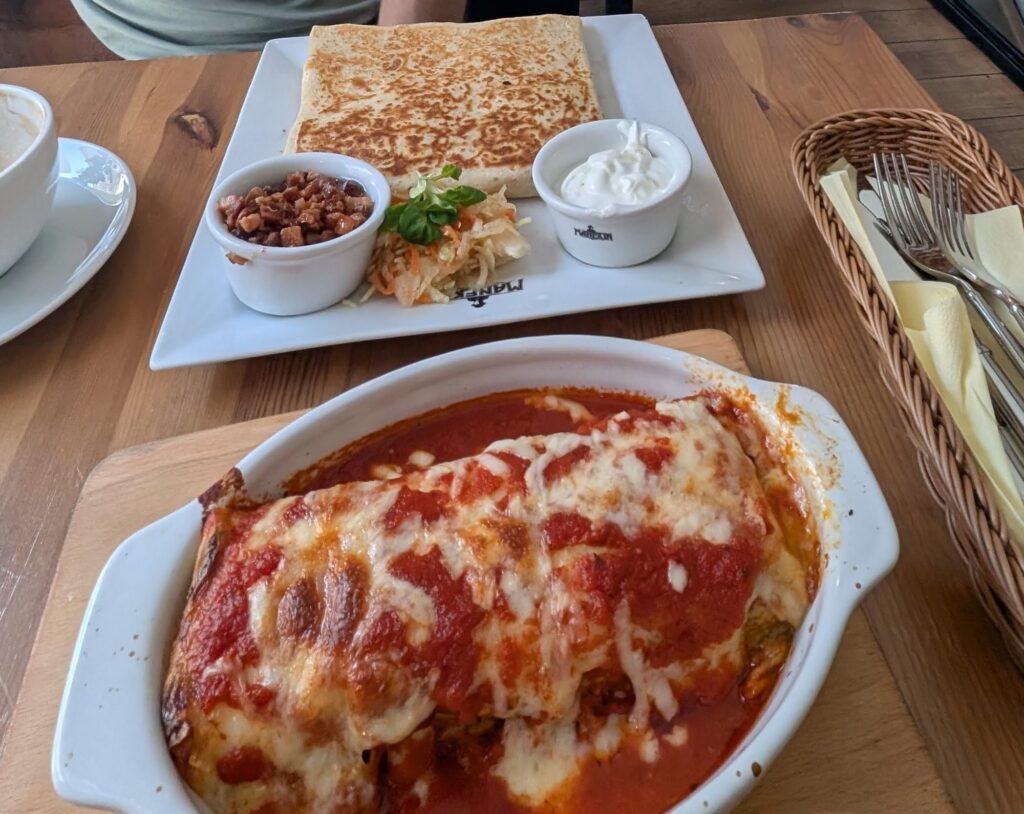
Where to try: There are quite a few places to try this relatively common brunch food. The best rated is Manekin, a Polish chain of pancake-focused cafes with quirky designs. We went to the one near the Stary Browar and were very happy with the food. We got a traditional potato, cheese, and pork one, and a less traditional lasagne one. Both were great, but the food took around 40 minutes to arrive, probably as the lasagne naleśnik took longer to cook and was not ordered so often. So, maybe stick to the more traditional options.
2. Pączki
Description: Fried doughnuts, made with enriched dough and a little bit of vodka/grain alcohol (cooked off in the baking process). Denser but fluffier and less oily than other doughnuts. Served with various toppings, traditionally a sugar glaze, and fillings, including the traditional sweet cheese, creams, and fruit jams.
Sweet/Savory: Sweet.
When to eat: Any time!
Price: 4–8 zł = €1.13–1.89 per piece.
Portion size: One is probably enough per person.
Goes well with: A coffee.
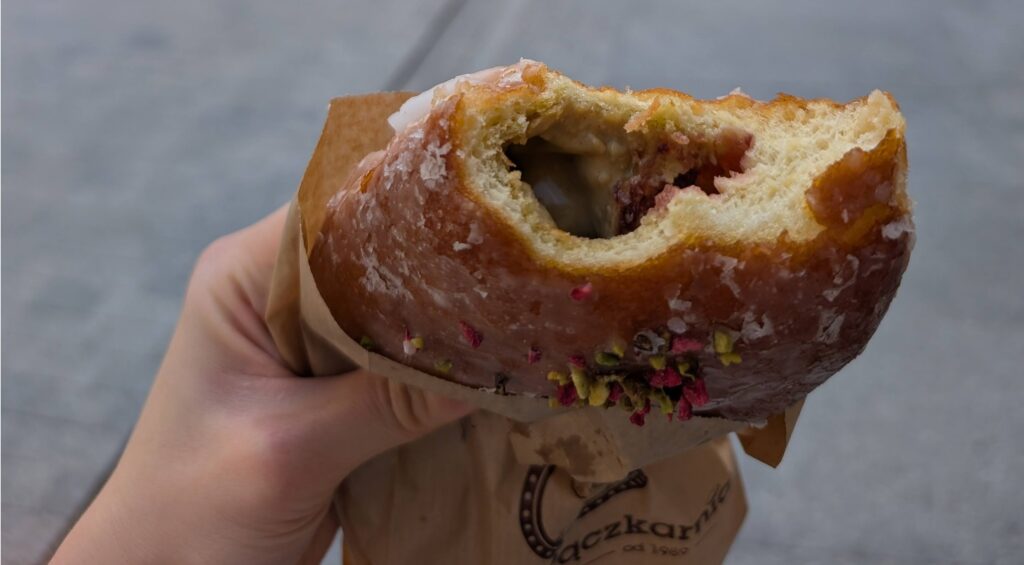
Where to try: If you haven’t tried pączki before, you are missing out! The enriched dough makes the Polish version much more satisfying than other doughnuts. You can get these at pretty much any bakery (piekarnia). We tried a few places and preferred those at the Dobra Pączkarnia, a Polish chain with a store nearby the Stary Browar. Just go to the window, pick out your flavour (or flavours. We wouldn’t blame you!), and immediately get your delicious pączek. We especially recommend the cherry jam, pistachio and raspberry, and sweet cheese fillings.
3. Zapiekanka
Description: Open-faced toasted baguette sandwich, topped with cheese, mushrooms, a sauce (often, ketchup or garlic mayonnaise), and sometimes other toppings, such as sausage or ham.
Sweet/Savory: Savory.
When to eat: For lunch, or as a quick snack shared between two.
Price: 20–30 zł = €4.70–7.05 per piece.
Portion size: One is a good-sized lunch for one person, or an on-the-go snack for two.
Goes well with: A soft drink or beer.
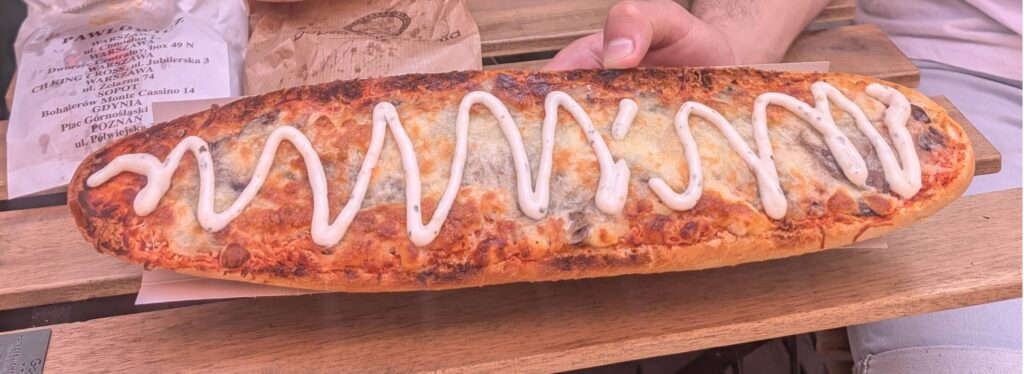
Where to try: A Poland-wide food, the zapiekanka can be found in quite a few places, especially those that stay open later. We shared a traditional mushroom and cheese one at BIMBA, a small cafe operating out of a converted tram. The zapiekanka was great, and we could have had more. There’s also Zapiekanki Wrocławska, a Polish chain that has a location closer to the Market Square. While we heard good things about this place, we didn’t get a chance to try it out.
4. Pierogi
Description: The classic Polish dumplings, made from a simple flour dough then stuffed with various fillings. Traditional fillings include potato, cheese, cabbage, and berries, but many variations exist
Sweet/Savory: Mostly savory, but sweet options also exist.
When to eat: Lunch or dinner.
Price: 12–38 zł = €2.75–8.75 per portion.
Portion size: Depending on their size, 6–10 per person.
Goes well with: Melted butter, bacon, and soured cream, with kompot, beer, or vodka on the side.
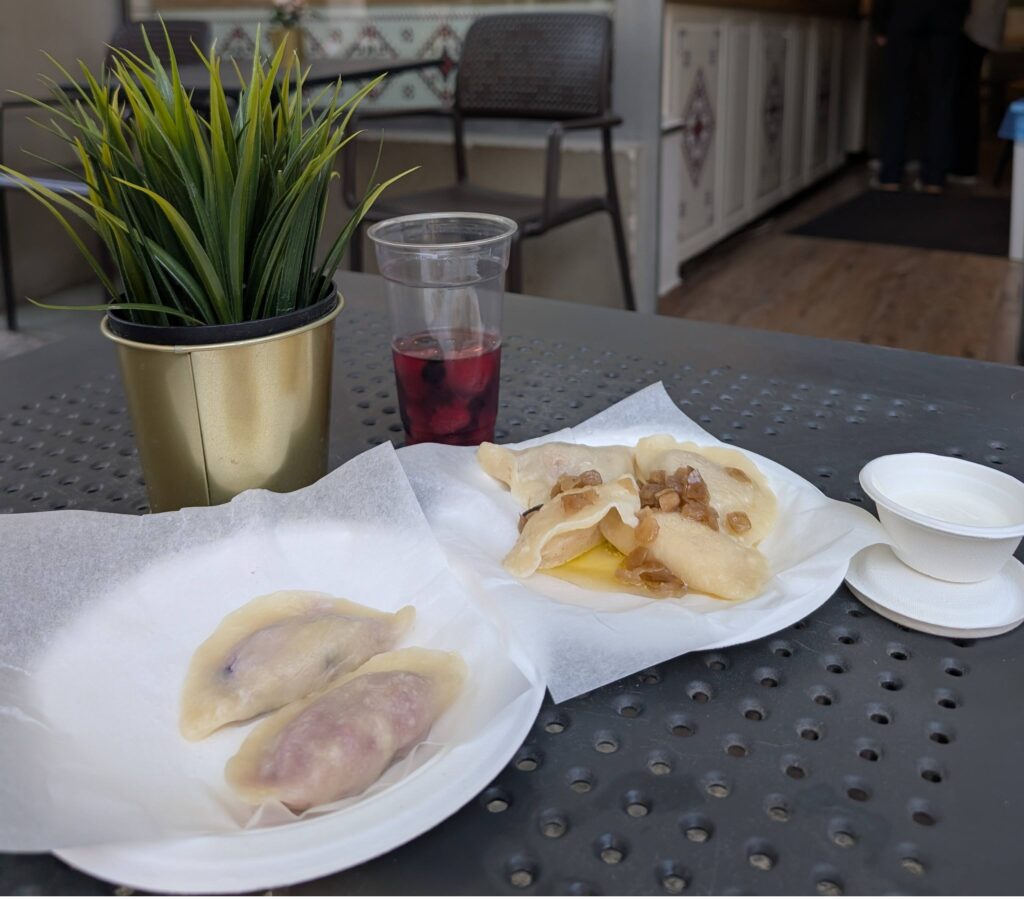
Where to try: Our absolute favourite Polish food, and in fact the national dish of Poland, pierogi really need no introduction. While Scone still prefers vareniki (according to him, their dough is thinner and softer), you really can’t go wrong with a plate of these dumplings. Most places will boil their pierogi, although you might find a few that fry them. We much prefer the boiled version, doused in butter and soured cream. You can find these pretty much everywhere. The best value we had were at the well-known chain, Pierożak Pierogarnia, where you can order one pieróg of each available filling, which is exactly what we did! All were great, but we preferred the traditional potato and cheese by quite a lot. We visited the branch closest to Market Square, but we heard all the branches are essentially the same. For a more independent and less busy option, head to Little Pieróg and Little Kompot (Pierożek i kompocik), a cute restaurant offering pierogi and other Polish specialities. If you have time and space in your stomach, we recommend trying both out.
5. Baked Pierogi
Description: The classic Polish dumplings, but bigger, baked in the oven rather than fried or boiled, and made with a yeasted enriched dough.
Sweet/Savory: Savory.
When to eat: Lunch or dinner.
Price: 20–35 zł = €4.70–8.26 per portion.
Portion size: 3 per person.
Goes well with: A soft drink or beer.
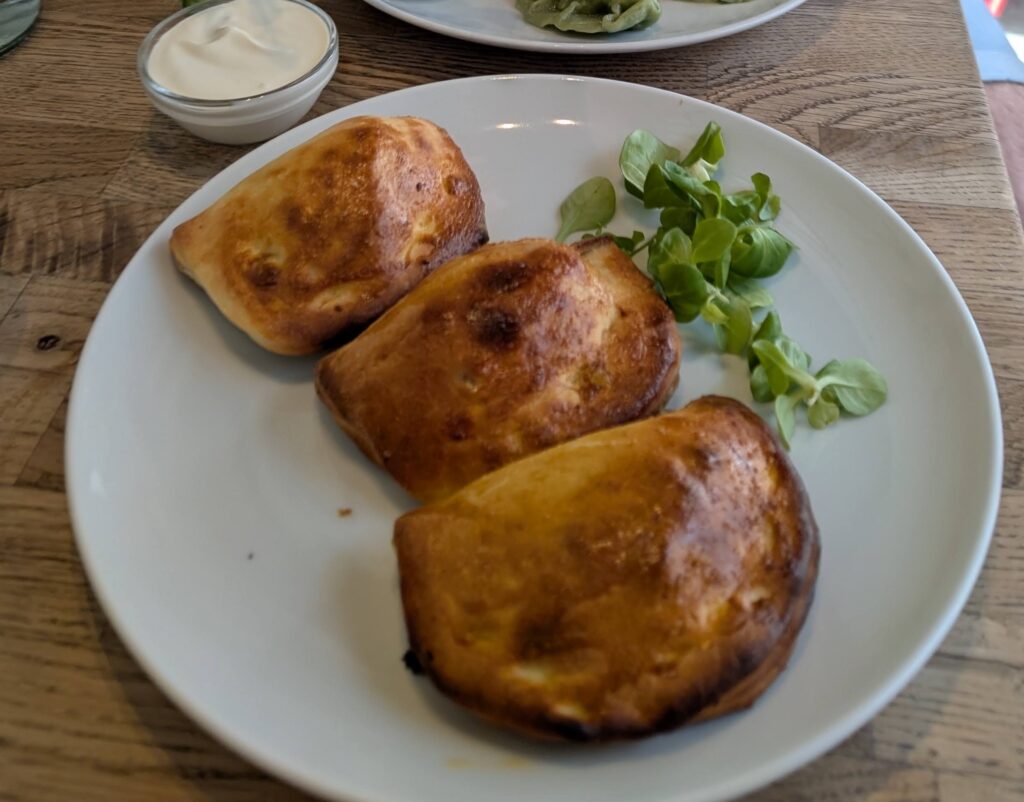
Where to try: Less frequently available and often associated with holidays, baked pierogi are worth a try, even if we liked them less than their boiled counterparts. There’s a few places that do them in Poznań. We tried them at Na Winklu (‘On the Corner’), about a minute away from the famous Mural Śródka and a few minutes’ walk from the Cathedral. Here, you can order a tasting selection, where you can choose 3 different fillings to try. If you’ve tried English pasties before, then you know what to expect here, as baked pierogi are pretty much the same, if a bit flakier. You can also try regular pierogi here, but they didn’t hit the spot for us: they were too refined and a bit fancy, and honestly didn’t really feel like pierogi. Definitely come for the baked ones, but we advise going elsewhere for the boiled version.
6. Kopytka
Description: Classic peasants’ food, similar to Italian gnocchi. Diamond-shaped dumplings made from potato, flour, and eggs, boiled then served with soup, stews, meat, and vegetables.
Sweet/Savory: Savory.
When to eat: Lunch or dinner.
Price: 19–38 zł = €4.48–8.97 per portion.
Portion size: Around 15 per person, depending on dumpling size.
Goes well with: Some soured cream, bacon, dill, and roasted meat, in particular Poznań-style duck.
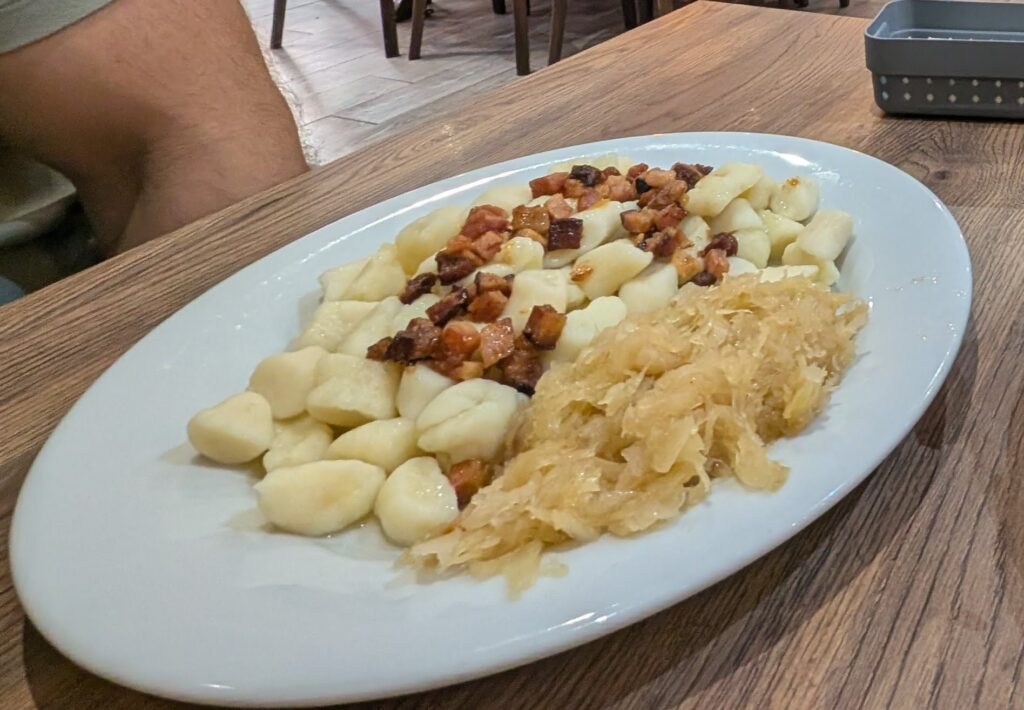
Where to try: Kopytka are super versatile and can be served with many things, as a side or as the main dish. By themselves, they don’t taste of much. However, together with soured cream and meat, they make for an incredibly hearty and comforting meal. We wanted to try kopytka at one of the remaining Milk Kitchens, remnants of Poznań’s Communist past in the form of local cafeterias. Instead, we went to a restaurant much closer to the centre, Schaboszczak od Dziadka (‘Grandpa’s Pork Cutlet’). Despite being about a minute from the Market Square, this place is very much a locals’ restaurant, and serves a daily-changing menu with large portions and low prices. The service was quick and friendly, and the food was fantastic. We really recommend this place!
7. Poznań-style Duck (Kaczka po poznańsku)
Description: A roasted full or half duck, rubbed with marjoram and stuffed with apples.
Sweet/Savory: Savory.
When to eat: Dinner.
Price: 40–90 zł = €9.44–21.23, depending on whether you get a half or full duck.
Portion size: One duck between two, with sides, is more than enough.
Goes well with: Cabbage salad and potato dumplings, either kopytka or pyzy (large round potato, flour, and egg dumplings).
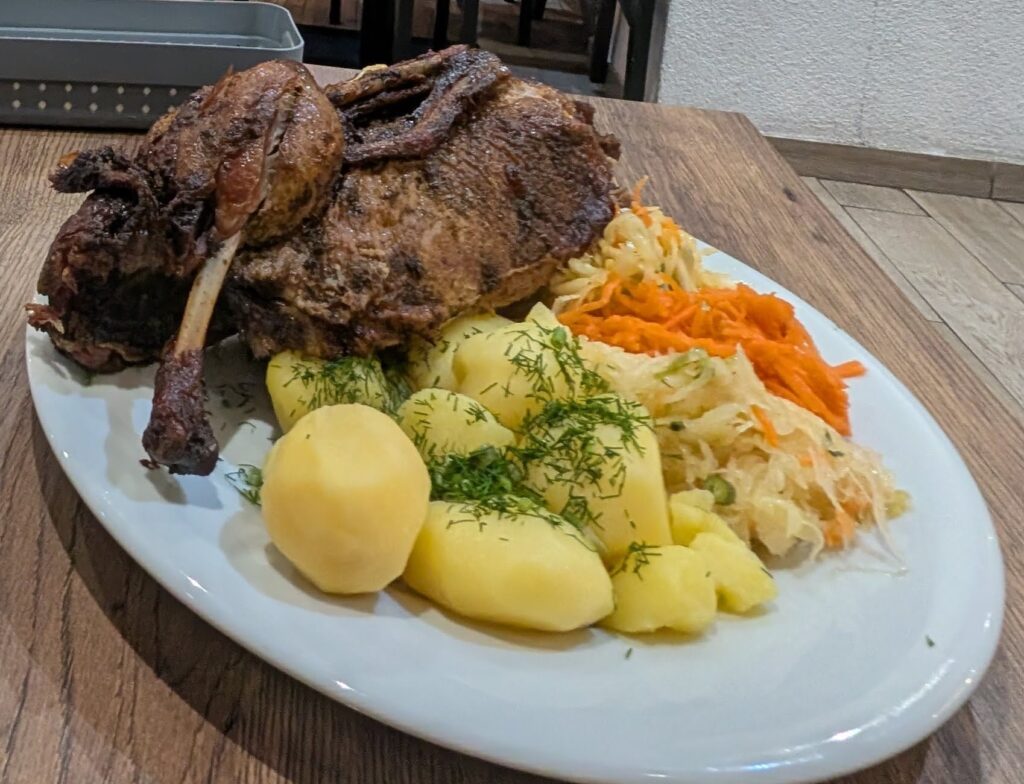
Where to try: One of Poznań’s signature dishes and not one to miss, we found Poznań-style duck less greasy and more flavourful than other versions of the meat. You can get this at many restaurants serving traditional food. We tried this with our kopytka at Schaboszczak od Dziadka (‘Grandpa’s Pork Cutlet’), and were really impressed with the quality of the meat. Despite the low price of only 42 zł = €9.91, we left stuffed and very happy with the meal.
8. St Martin’s Croissant (Rogal świętomarciński)
Description: A dense and sweet croissant, filled with a poppy seed, almond, and dried fruit paste, then topped with sugar glaze and nuts. Much heavier and more flavourful than the traditional French croissant.
Sweet/Savory: (Very) sweet.
When to eat: As a snack.
Price: 14–30 zł = €3.25–7.00 per piece.
Portion size: A hungry person with a sweet tooth can have one, but, owing to its density and sweetness, we recommend either sharing one croissant between two people or saving part for later.
Goes well with: Black coffee or tea.
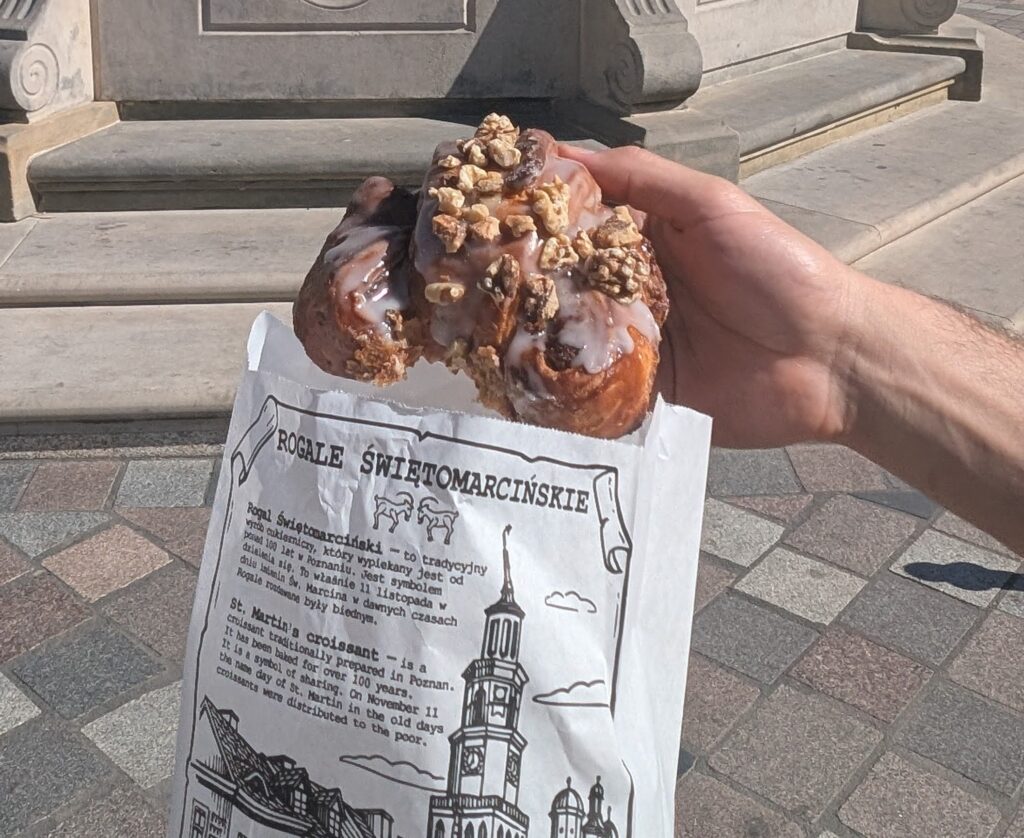
Where to try: Another of Poznań’s classic foods. Traditionally, St Martin’s croissants are made to celebrate the feast day of St Martin of Tours, held on 11th November. While you can sometimes find these pastries elsewhere in the country around this date, Poznań has them year-round. You really have to try these and we loved them, but could not finish one in one go. Apparently, only bakers who have been certified can make and sell them, but you shouldn’t have a hard time finding one. One of the classic places to buy one is at ROGAL Świętomarcińsk , right in the Old Market Square. As you can see from the picture, there’s always plenty available at the bakery. But another fun option would be to go to the nearby Croissant Museum, where, for 47 zł = €11.09, you can learn about the history of the pastry and how to make it yourself, followed by a tasting. We didn’t get a chance to go to the Museum, but have heard it’s a great thing to do.
9. Kompot
Description: A syruppy fruit drink, made from boiling berries, apples, pears, peaches, and/or raisins in sugared water. Served hot or cold as a drink, it can also be boiled down further to make a dessert, essentially the same as the French compote.
Sweet/Savory: Sweet.
When to drink: Any time, especially with food.
Price: 14–30 zł = €1.50–3.75 per glass.
Portion size: One glass.
Goes well with: Pierogi and other main dishes.
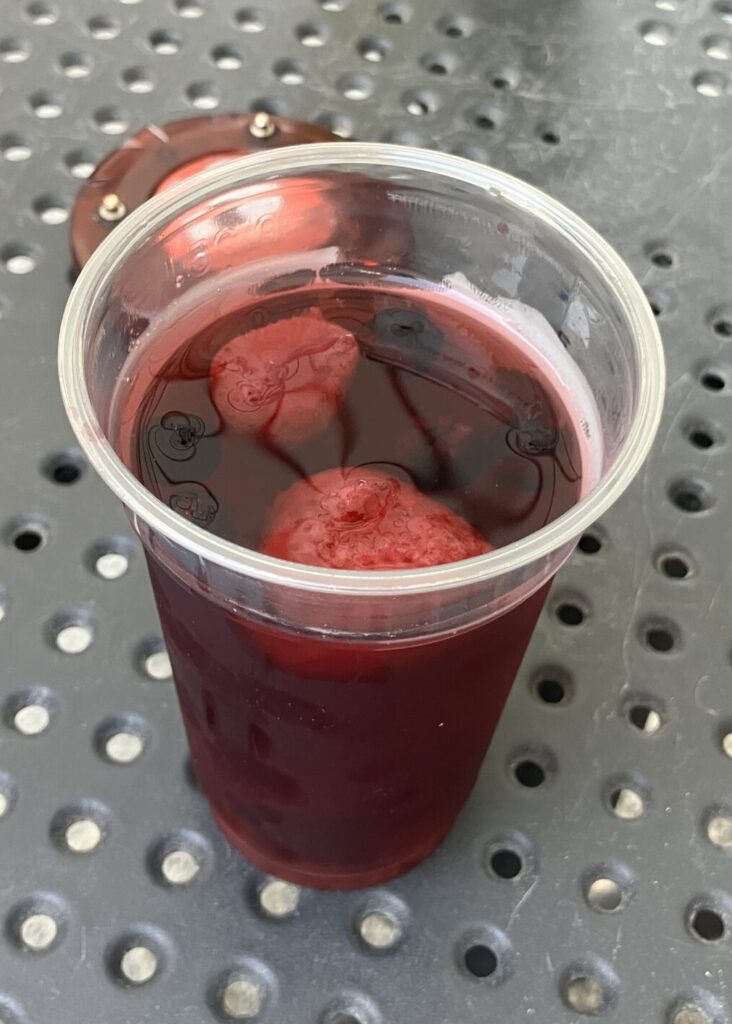
Where to try: Kompot is not unique to Poland, and is present in many neighbouring cuisines across Europe and Asia, but it’s also a prominent feature of many traditional Polish celebrations and gatherings. You can try a glass at pretty much every traditional restaurant. We had one at Pierożak Pierogarnia with our pierogi and enjoyed it. Just remember that kompot is incredibly sweet: you may want some water alongside it.
10. Wiśniówka
Description: Polish version of Ukrainian vyshnivka (вишнівка). Cherry-infused sweetened vodka, ranging between 17% and 45% alcohol content.
Sweet/Savory: Sweet.
When to drink: As an aperitif or digestif.
Price: 8–35 zł = €1.85–8.10 per glass at bars. 7–95 zł = €1.60–22.10 per bottle, depending on size and whether bought at a supermarket or from a specialist seller.
Portion size: 1–2 glasses, but it can be hard to stop…
Goes well with: Salty snacks and meats.
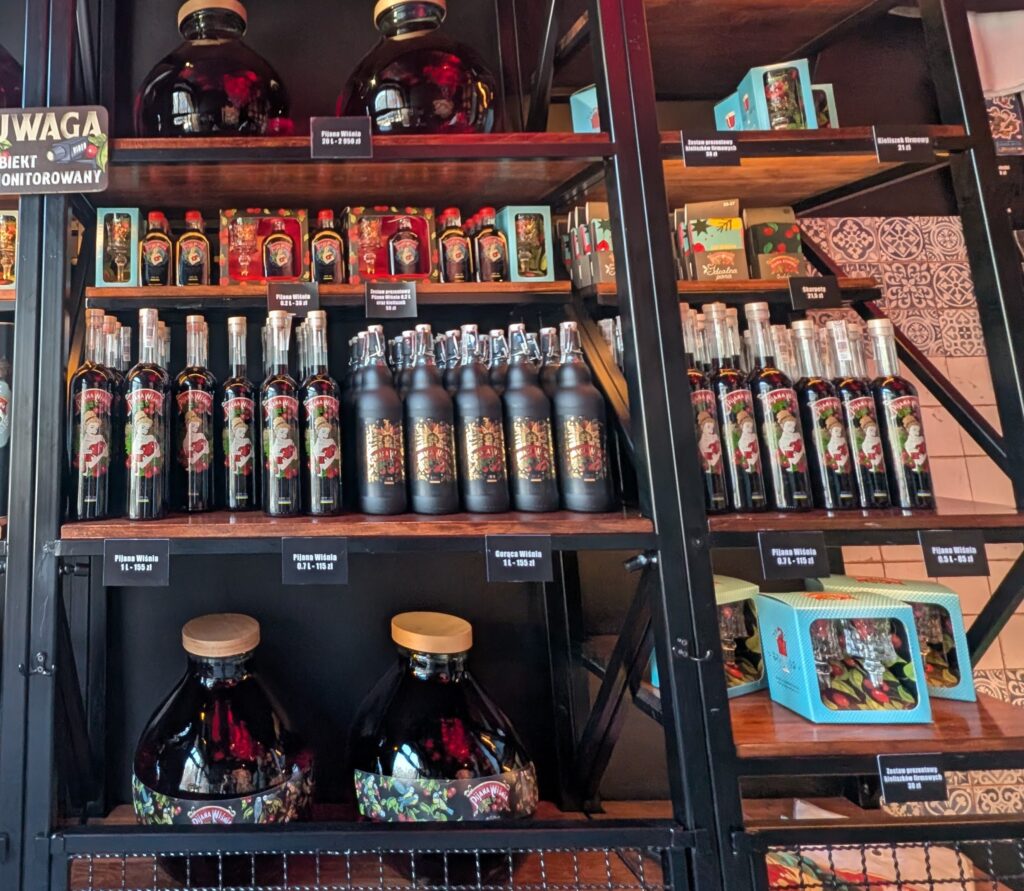
Where to try: As one of Poland’s favourite alcoholic drinks, you’ll probably find this delicious liqueur in most bars, if not also most pubs and traditional restaurants. That said, there are a few places that stand out as exceptionally worth visiting. The first is the local branch of the Lviv chain, Pijana Wiśnia (П’яна Вишня), where you can buy bottles, glasses of the liqueur served hot or cold, cherry chocolate, and various merch. The chain has a special place in Scone’s heart, given that it’s from his family’s home city, and the Poznań branch doesn’t disappoint, with its quirky decoration and tasty drinks. Another good option is Wiśniewski, a Polish chain which produces high-quality Wiśniówka you can sample by the bottle or by the glass. It’s worth noting that while both Pijana Wiśnia and Wiśniewski are fantastic, they’re also on the expensive side. If budget is an issue, it would be better to head to a supermarket such as Biedronka or Lidl to grab a bottle.
11. E. Wedel Hot Chocolate
Description: Essentially a hot chocolate, but made in large part from E. Wedel’s signature chocolate (dark, bittersweet, milk, or white) melted then mixed with frothed milk.
Sweet/Savory: Sweet.
When to drink: In the day, ideally before or while you’re walking around.
Price: Starting from 21.90 zł = €5.16, depending on size and extras added.
Portion size: A small cup is probably enough for one person. Those with a sweet tooth might want to go for a larger size.
Goes well with: Cakes and ice cream.
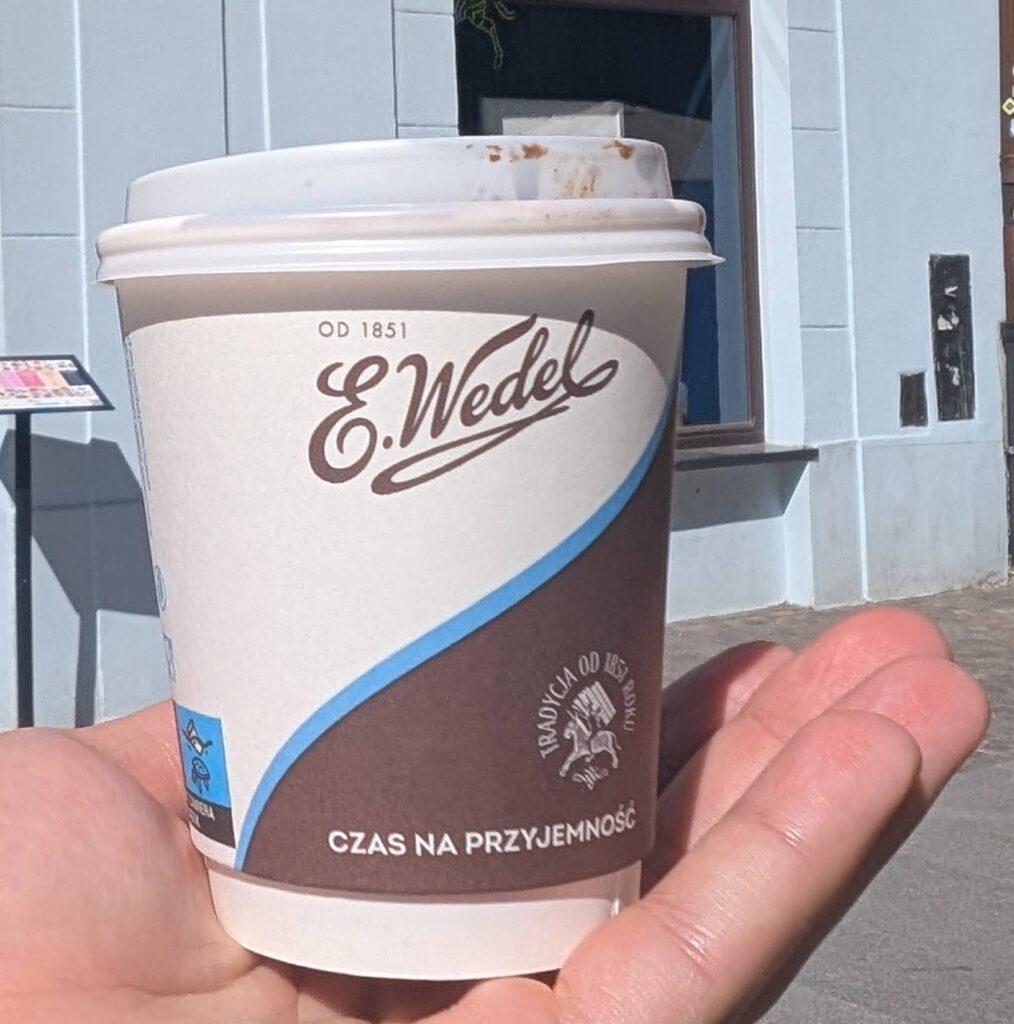
Where to try: At this point, you may be thinking “Really? Another chain?!” And it’s true, you can find this chocolatier in most major Polish cities. Even so, we had to include this entry, as the chocolate is that good. E. Wedel is essentially Poland’s national chocolatier, with cafes that offer a wide range of cakes, treats, hot drinks, ice cream and parfait. Locals come here for dates, lunches out with friends and family, to treat their kids, and essentially any occasion to indulge in some excellent chocolate. In our opinion, the best item is the drinking chocolate, where you can choose from dark, bittersweet, milk, or white chocolate, which is then melted and mixed into frothed milk. You can then add various things, such as cream, toppings, and even a shot of alcohol. Poznań has two branches, one right in the Market Square and one a bit further out, in the Posnani shopping mall. For a luxurious treat that will give you energy for exploring the city, consider stopping by the Market Square location and grabbing a dark chocolate drink.